Solar Together: how the council group buy works, and how to test its offer
How the council group-buying auction works, what an independent London evaluation found, and how to test an offer against DESNZ cost data.
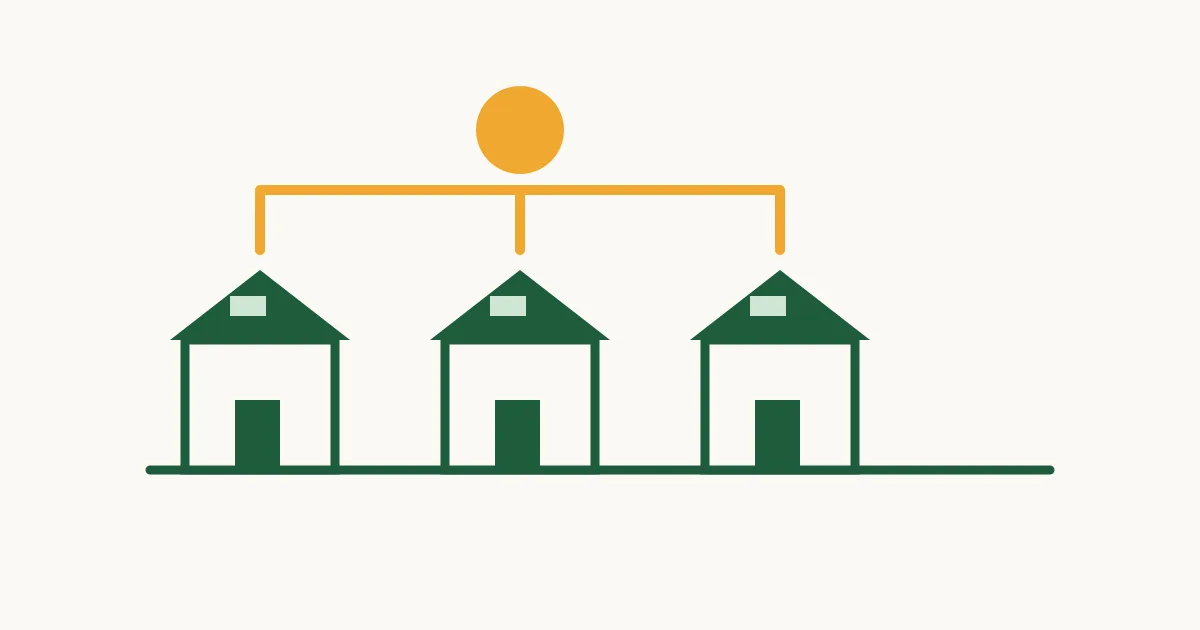
This scheme is not a grant. Nobody pays part of your bill. It is a way of buying: a council invites residents to register, an intermediary collects them into one group, installers bid against each other for the group’s custom, and each household then gets an offer it can take or leave. Whether that produces a better price than getting three quotes yourself is a question you can answer with a number, and the number is public.
This article explains the mechanism, what the people who run it say about price, what an independent evaluation found when one was done, and how to hold your own offer against the government’s installation cost data. Everything is as read on 25 October 2026.
What it is, and what it is called now
The scheme is run by iChoosr Ltd, a private company. Its own site says it launched Solar Together in 2015, after an earlier group switching scheme in 2012, and that the business now trades as Switch Together. Councils still use that name in their press releases, and the original web address now shows the Switch Together branding, so you will meet both. The Warm Homes Plan itself cites Solar Together as a “long-standing example” of collective buying that “enabled thousands of households to access solar panels at lower cost”.
It is not run by the council. The council signs up as a partner, publicises the scheme to its residents and lends its name. The solar panels, the installation and the warranty come from the installer that wins the auction. Switch Together’s terms say the products and services “are not provided by iChoosr, but by third parties (the Installers/Suppliers) over whom iChoosr has no control”. How iChoosr itself is paid is not stated on the pages I read.
How the auction works
From the scheme’s own pages, the steps are:
- Register. It is free and without obligation. A short survey about your home and energy use is used to build a personal offer.
- The auction. Behind the scenes, iChoosr runs an auction in which vetted installers bid to offer the best value and quality for the whole group. A council release from June 2024 describes it as a reverse auction, with installers competing to offer the group the best price.
- Your offer. An email arrives with an estimated system size, cost, savings and installer details, based on your home and the auction result.
- You decide. You can accept or walk away “no strings attached”.
- Survey and installation. A qualified installer surveys the roof to confirm what it can take, then installs.
Two points follow from this. Registration does not promise an offer: the terms say enrolment “is not a guarantee that the Installer/Supplier can provide the Participant with an offer”, because installers have limited capacity. And the price in your offer is an estimate until the roof survey, so the figure can change once the installer has seen the house.
Every local scheme has its own registration, decision and installation dates, and they differ from council to council, so check the page for your area rather than a national one.
What it says about price
Scheme material makes a claim about savings. A June 2024 release by Wiltshire Council and Swindon Borough Council, which ran the scheme with iChoosr, says iChoosr has helped facilitate “over 33,000 installations with 10-25 per cent savings against the market average” across the country. That is the operator’s figure, repeated by a council. It does not say what “market average” means, what period it covers or which installations it counts, so it is a claim to test, not a result.
The test is available. What a typical small installation costs is published, by a government department, every year.
The benchmark: DESNZ’s installation cost data
The Department for Energy Security and Net Zero publishes small scale solar PV cost data built from the MCS installation database. For installations of up to 4 kW in the 2025/26 financial year, the median cost is £1,780.25 per kilowatt, on its declared net capacity basis. The mean is £2,008.32, pulled up by the dearer installations, which is why the median is the fairer yardstick for a typical home.
At that median:
| System | At £1,780 per kW | 10% below | 25% below |
|---|---|---|---|
| 3 kW | £5,340 | £4,806 | £4,005 |
| 4 kW | £7,120 | £6,408 | £5,340 |
The right hand columns show the scale of the operator’s claim if it applied exactly to the median, which it may not: the claim is against a “market average” it does not define, and DESNZ’s figure is a median. It is a way of seeing how big 10 to 25 per cent is, not a promise of those prices.
Two other points make the comparison fair. First, compare like with like: the scheme sells batteries and EV chargers as options, and an offer that includes a battery is not comparable with a median for panels alone. Second, another number is in circulation. Switch Together’s own price page quotes an MCS Dashboard average of £1,656 per kilowatt for January to August 2026. It does not say which capacity basis that figure uses, so it should not be set beside DESNZ’s without that being established; DESNZ itself notes that costs per kilowatt on its two capacity bases differ by 6 to 12 per cent.
What an independent evaluation found
The scheme has been evaluated independently at least once. The Greater London Authority commissioned AECOM to evaluate Solar Together London, and its final report, dated 27 June 2024, covers five phases from 2019 to 2023. It is the most detailed independent assessment I found, and it is balanced.
On price it found savings, but with a wide spread and a caveat about the yardstick. It compared the bids of the installers it had prices for against the average installation price in London from MCS data at the time. Savings ranged from -29.6% to 33.1% in Phase 3, 2.1% to 43.6% in Phase 4, and 10.4% to 37.3% in Phase 5, depending on system size and installer. The negative figure is a small system priced above the London average. For systems of roughly 2 to 4 kWp, the middle band of a typical home, the estimated savings in the three tables it published were 19.1%, 13.6% and 23.9%. The report says those are conservative estimates because the scheme itself was a large share of London installations and so pulled down the average it was measured against.
It also found limits, and these matter to a household:
- Specification. Some elements of the equipment iChoosr specified were “lower than would typically be expected of a domestic rooftop solar PV specification”, with lower quality inverters named, which “will have likely contributed to some of the cost reduction”, and might lead to more warranty claims later. The report says it could not obtain the procurement documents or the quality threshold, so it could not assess whether the standard was right.
- Conversion. Of 72,330 registrations over the five phases, 10,076 (13.9%) accepted an offer and 3,233 (4.5%) ended in an installation. Reasons for cancelling included a changed mind, no contract, and an unsuitable roof.
- Supply failure. An installer that won one phase failed during it, and customers were moved to another supplier. Complaints rose and the report links that failure to lower take up.
- Market effect. Installations in London followed the national trend, and the evaluation concluded the scheme appeared to have had limited impact on the number of installations, suggesting it helped people who were going to install anyway.
That is one region, covering 2019 to 2023, and one evaluator. It does not describe every scheme in every county. It does show the shape of what to ask.
A worked household
A household has a south facing roof that takes 10 panels of 400 W, a 4 kW system, and uses 3,600 kWh a year. Its group offer, for illustration, is £6,300 for that system without a battery. Its two open market quotes are £7,400 and £6,900.
Per kilowatt the offers are £1,575, £1,850 and £1,725, against DESNZ’s median of £1,780. The group offer is about 11.5% below the median and the other two sit above and slightly below it. On those figures the group offer is the cheapest of the three, by £600 against the lower open market quote.
That is the answer to “is it cheaper?”, for this household, on these quotes. The decision also depends on the specification (inverter make and warranty length), the installer’s MCS certificate, and what the offer excludes, such as scaffolding or a consumer unit upgrade; see what is in a solar quote and why two quotes differ. The widget compares an offer with the median for any size you enter.
- 850 kWh per kW a year for a south facing roof (the site model's figure, not a measurement), scaled by the calculator's direction factors shown in the list.
- Pitch and shading are not modelled here. For a roof-specific figure use PVGIS, which is free, or the MCS estimate on the quote.
- Medians are the DESNZ median installed cost per kW, 0 to 4 kW (£1,780) and 4 to 10 kW (£1,697), 2025/26 edition, published 28 May 2026, confirmed against the spreadsheet 2026-10-19. No larger domestic band is published.
- The quote starts at the median for the size shown, so the comparison reads zero until you enter your own total. 440 W per panel is the posts' worked figure; use the wattage on your quote.
Illustrative arithmetic on the inputs shown. For a projection with degradation, replacement and your tariff, use the calculator.
A second household with a larger roof and a 7 kW system has no 0 to 4 kW median to compare with; the 4 to 10 kW band has its own, discussed in the 6 kW cost article. The method is the same: per kilowatt, against the right band, like for like.
How to use it well
- Register, and keep your own quotes going. Registration is free and without obligation, so it costs nothing to see the offer. Get two open market quotes at the same time, as in why two quotes differ.
- Ask who the installer is, and what MCS certificate they hold. The scheme describes its installers as vetted for experience, accreditations, customer service, safety standards and financial stability. Check the MCS register yourself too; see choosing an installer.
- Ask for the specification in writing, including inverter, panel make and workmanship warranty, given the evaluation’s finding on specification.
- Treat the offer as an estimate until the roof survey, and ask what happens to the price if the survey changes the system.
- Use the price per kilowatt, not the total, when comparing different sizes. Cost per kilowatt peak is one division.
Questions people ask
Is this a government scheme?
No. It is a group buying scheme run by a private company, iChoosr, which now trades as Switch Together, in partnership with local councils. The government has cited it as an example of collective buying, but it is not a grant and does not fund your installation.
Is the group buy cheaper than getting your own quotes?
Sometimes. The operator claims 10 to 25 per cent below the market average, a council release repeated that in June 2024, and a London evaluation found savings in most bands but a range from a negative saving of 29.6% (a small system priced above the London average) to a saving of 43.6%. Test your own offer per kilowatt against DESNZ’s median and your own quotes.
Do I have to accept the offer?
No. Registration is free and without obligation, and the scheme says you can walk away “no strings attached”. Offers and installation windows are set by the local scheme.
Does the group buy include a battery?
Solar panels with optional battery storage, and EV chargers, are offered in council releases, and the scheme has a battery only route for people who already have solar. A price with a battery cannot be compared with a panel only median.
What if the installer fails after I accept?
The terms say the products and services are the installer’s, not iChoosr’s, and the 2024 London evaluation records an installer failing in one phase, with customers moved to another supplier. Pay by a method that carries protection, and see how to read a quote before signing.
Check your own numbers
Take the offer, divide by the system size in kilowatts, and put the result beside £1,780. Then put the system into the calculator and see the payback at the price you were offered, starting from a south facing 4 kW system on 3,600 kWh a year: open the calculator with the worked example loaded.
Sources
- Switch Together (iChoosr Ltd), how the scheme works, group buying, about us, terms and conditions, and solar panel price pages: registration, auction, personal offer, no obligation, 2015 launch, installers responsible for products, MCS Dashboard £1,656 per kilowatt for January to August 2026. Checked 2026-10-25, switchtogether.co.uk.
- Swindon Borough Council, Trusted solar panel installation available at lower prices for residents through group buying initiative Solar Together, 17 June 2024: reverse auction, “over 33,000 installations with 10-25 per cent savings against the market average” (iChoosr’s figure). Checked 2026-10-25, swindon.gov.uk.
- AECOM for the Greater London Authority, Solar Together London Programme Evaluation Final Report, 27 June 2024: price savings by phase and band, specification caveat, registrations, acceptances and installations, supplier failure. Checked 2026-10-25, london.gov.uk.
- DESNZ, Solar PV cost data, 2025/26 edition published 28 May 2026: 0 to 4 kW median £1,780.25 and mean £2,008.32 per kilowatt (declared net capacity basis); the note that costs per kilowatt on the total installed capacity basis are typically 6 to 12% lower. Checked 2026-10-25, gov.uk.
- DESNZ, Warm Homes Plan: Solar Together cited as a long-standing example of collective buying. Checked 2026-10-25, gov.uk.
- The household offer and the two open market quotes are illustrations, labelled as such.
Related
- Cost per kWp: the only figure that compares two quotesWhy the headline total tells you almost nothing, and how one division makes three quotes comparable.
- How to read a solar panel quoteLine by line, with the questions that expose an inflated generation estimate and the exclusions that turn up after you have signed.
- How to choose a solar installerSix checks that separate a surveyed quote from a templated one, none of which are about price.