What a 6kW solar system costs, and who it suits
A larger array priced against the 4kW default, and the consumption pattern that justifies the step up.
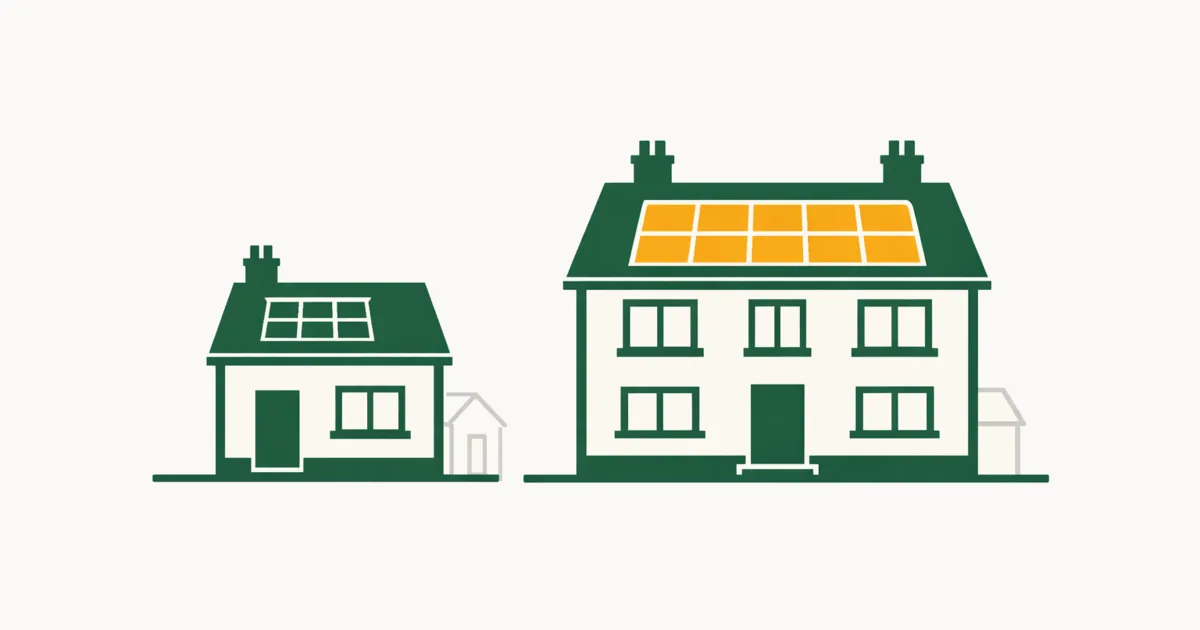
Six kilowatts is roughly twelve to fourteen modern panels, and it is the step up most households should at least price against the four kilowatt default.
The reason is not that bigger is better. It is that the extra capacity costs much less per kilowatt than the first four did, which the government’s own cost data shows directly, while what it earns depends entirely on whether you can consume it, which is where the modelling has to happen.
Why the step up is cheap, in the official numbers
The DESNZ installation cost data for 2025/26 puts the median at £1,780 per kilowatt for systems up to 4kW and £1,697 for the 4 to 10kW band. Apply those medians and a 4kW system prices near £7,100 while a 6kW system prices near £10,200.
Look at the step itself: roughly £3,100 buys the extra two kilowatts, which is about £1,550 per kilowatt, cheaper than either band’s median. The reason is structural: scaffolding is priced by the property, the survey, certification and network paperwork are fixed, and the whole fixed block spreads over more capacity. Going from four kilowatts to six adds panels, mounting hardware and some labour, but almost nothing else.
Divide each quote by its capacity and compare, cost per kWp being the only figure that compares sizes. A six kilowatt system should show a distinctly better rate than a four kilowatt one on the same roof, and the medians above give you the external check.
The two things that have to be true
Roof area. Twelve to fourteen large-format panels need somewhere to go, on pitches facing between east and west through south. On a modest terrace with one small usable pitch, six kilowatts may simply not fit, and the measuring method settles it with a tape measure.
Consumption you can absorb. This is the binding constraint more often than roof area, and it is the one people skip.
Work the honest example. A household using 3,600 kilowatt hours a year with 40% daytime occupancy, at the capped 26.11p import and 12p export:
- 4kW, generating about 3,400 kWh: roughly £600 a year.
- 6kW, generating about 5,100 kWh: the household’s daytime consumption is already nearly saturated, so almost all the extra output exports at 12p. Roughly £815 a year.
The marginal £215 a year against the marginal £3,100 is a fourteen year payback on the step, worse than the system’s own eleven. For this household, the cheap capacity is cheap to buy and poor at earning, because every extra unit sells at less than half the import rate.
Who six kilowatts suits
The step pays when something lifts the consumption ceiling:
- An electric car charged at home, adding two or three thousand kilowatt hours a year of demand that can meet the extra generation.
- Electric heating, or a heat pump.
- Someone home during the working day.
- A battery, which lets evening consumption draw on the extra midday output and converts export-rate units into import-rate ones.
- A plan to add any of the above within a couple of years.
That last one matters. Adding panels later means paying for scaffolding, a survey and a site visit a second time. If the consumption is coming, size for it now: the £1,550 per kilowatt step never gets cheaper than while the scaffold is up.
The same step with the ceiling lifted
Rerun the marginal arithmetic for the household the step actually suits, because it transforms. Give the same house an EV charged partly in daylight and a home worker: usage 6,500 kilowatt hours, daytime share 45%, daytime consumption 2,925. Now the 6kW system’s 5,100 kilowatt hours meet a ceiling that is no longer saturated: roughly 2,295 self-consumed at 26.11p is £599, with 2,805 exported at 12p for £337, about £935 a year. The 4kW version on the same household earns around £625, so the step now returns £310 a year on its £3,100: a ten-year marginal payback instead of fourteen, and better again with a battery converting the export line to import value or the EV’s daytime charging absorbing the surplus directly.
The honest generalisation: the step from four to six kilowatts is bought cheaply and earned slowly on today’s rates unless something, occupancy, a car, storage, a diverter, lifts the self-consumption ceiling with it. Size the consumption first and the array to it, never the reverse.
The inverter question
Check whether six kilowatts still fits the inverter in the quote, and which grid route the inverter’s rating triggers. Up to 3.68kW of inverter on a single phase is a G98 notify-after job; above it a G99 application must be approved before installation, which adds weeks. Six kilowatts of panels is commonly paired either with a larger inverter through G99, or with a 3.68kW inverter that keeps the paperwork simple at the cost of clipping on the brightest days.
Neither is wrong. Ask what array-to-inverter ratio has been specified, what annual clipping loss is expected, and whether the quoted timeline reflects the G99 wait if there is one. A competent installer has all three answers.
The network operator
Larger systems are more likely to attract attention from the distribution network operator, and in constrained areas an export limit may be applied as a condition of a G99 approval.
If a limit is expected, ask for the savings projection to be redone with it applied, because a projection assuming unrestricted export on a capped system overstates the return, and the overstatement lands precisely on the marginal capacity you are deciding about.
How to decide
Get both quotes, four and six kilowatts, from the same installer on the same roof. Then compare on:
- Cost per kWp for each, against the published medians.
- Estimated annual generation for each.
- Estimated annual saving for each, using your own consumption and your own import and export rates treated separately, which is exactly what the ROI calculator does when you flip the system size input between the two.
The difference in saving against the difference in cost is the return on the extra two kilowatts, judged on its own. If that marginal return is good, take it: it is the cheapest capacity you will ever buy. If it is poor, the roof is not the constraint; your consumption is, and the money does more in a battery, a diverter or simply your pocket.
Related
- What a 4kW solar system actually costs in 2026The most common domestic size, priced from government installation data, with a worked savings example and the reasons the price band is wide.
- Cost per kWp: the only figure that compares two quotesWhy the headline total tells you almost nothing, and how one division makes three quotes comparable.
- How many solar panels do I need?Sized from your own consumption and usable roof area, not from bedroom count or a salesperson's default.