SolarEdge inverters and optimisers: the datasheet figures, and when the optimisers pay
99.2% peak efficiency, a 98.6% optimiser stage, 12 to 25 years of warranty: what SolarEdge datasheets say, and when optimisers pay.
Explore this decision
Solar shading loss calculator: explore a generation scenario
Apply an assumed shading energy loss to baseline solar generation for the same period.
A shading energy-loss percentage is not the same as the percentage of panel area shaded.
This is a spec-and-sum explainer, not a review. Every figure comes from SolarEdge’s own datasheets and warranty document, as read on 25 October 2026, through the UK distributor and reseller copies that could be opened; where a figure is not in them it is marked “Not stated”. The arithmetic then asks what a SolarEdge system’s extra part, the optimiser fitted behind every panel, has to earn to be worth buying.
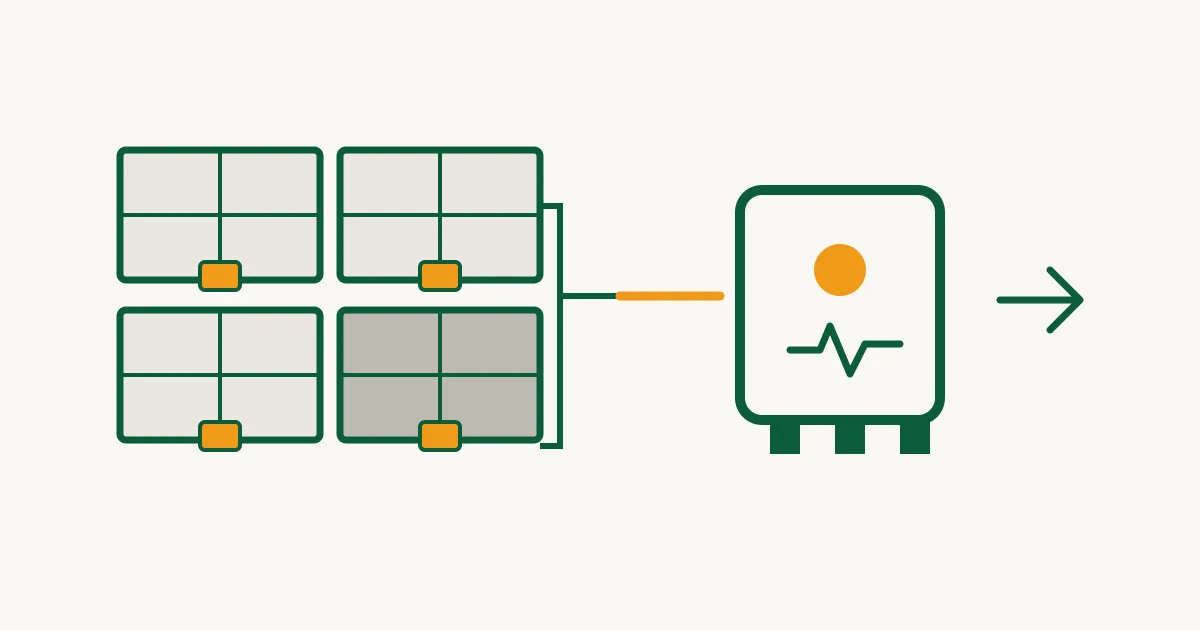
SolarEdge sells two things that are always used together: a Home Hub inverter, and a power optimiser on each panel. The design matters more than the brand, because the optimiser is what you are paying extra for, and the question is how much shade or roof complexity it takes before it returns that premium.
The two datasheets
| Home Hub inverter, single phase (SE2500H to SE10000H) | S440 power optimiser | Checked | |
|---|---|---|---|
| Rated output | 2,500 to 10,000 VA (SE3680H is 3,680 VA) | Rated input 440 W; 490 W for installations after 1 April 2024 | 2026-10-25 |
| Maximum DC power | 5,000 to 20,000 W (SE3680H is 7,360 W) | Not applicable | 2026-10-25 |
| Maximum efficiency | 99.2% | 99.5% | 2026-10-25 |
| European weighted efficiency | 98.3% to 99% by model | 98.6% | 2026-10-25 |
| Input range | 480 V maximum | 8 to 60 V per panel, 14.5 A short circuit (15 A after April 2024) | 2026-10-25 |
| Battery | SolarEdge Home Battery 400V, up to 3, 5,000 W each | Not applicable | 2026-10-25 |
| Backup output | 6,000 W (SE6000H) | Not applicable | 2026-10-25 |
| Protection rating | IP65 | IP68 | 2026-10-25 |
| Weight | 12 kg | 720 g | 2026-10-25 |
| Grid standards listed | G98 Type A, G98 NI Type A, G100 | Not applicable | 2026-10-25 |
| Warranty on the datasheet | “12-25 year warranty” badge | “25 year warranty” badge | 2026-10-25 |
| Warranty in the limited warranty document | 12 years (7 in some countries) | 25 years | 2026-10-25 |
| Price | Not stated | Not stated | 2026-10-25 |
Two points on the warranty line. The inverter datasheet’s badge reads “12-25 year”, which is a range, not a promise: the limited warranty document says 12 years for inverters, with a footnote that some countries get 7, and the route from 12 up to 25 is an extension that the datasheet does not price. The document read is the May 2020 edition, hosted by a German reseller; whether the UK is on SolarEdge’s list of 7 year countries was not checked, so confirm the inverter term for your address in writing. The optimiser term, 25 years, is the same on the datasheet and the document, and it starts on the earlier of four months after shipment and installation.
What the efficiency figures add up to
Every unit of energy from a SolarEdge system passes through an optimiser and then the inverter. The two efficiencies compound. With the optimiser’s 98.6% weighted figure and the inverter’s 98.3% to 99%, the pair delivers about 96.9% to 97.6%, which is 0.986 times each inverter figure.
Set that beside a plain string inverter, such as the Solis string family at 96.5% to 97.1% weighted. The headline “99%” inverter, once the optimiser stage is counted, lands in the same band. That is not an argument against the design: the weighted figures are measured differently by different manufacturers and the true comparison depends on conditions. It is an argument for not paying for “99%” as such. What the optimiser buys is not efficiency; it is that each panel works at its own best point.
When optimisers earn their price
The sum needs three numbers: what shade costs a plain string system, what the optimisers recover, and what they cost. The first is the MCS shade factor in your installer’s estimate; the shading article explains how to read it. The second is a fraction of the first. The third is the installer’s line, not a published figure: no UK price for the S440 or the Home Hub was found on the datasheets or the retailer pages searched, so the premium below is an illustration.
A worked household: the shaded semi
A 4 kWp array making about 3,400 kWh a year at the site model’s 850 kWh per kilowatt, with a chimney and a neighbour’s tree costing a plain string system 15%. That is about 510 kWh a year. Say optimisers recover 12 of those 15 points, 408 kWh, and half of it is used at home.
- Used at home: 204 kWh at the October to December 2026 cap of 26.32p: about £54
- Exported: 204 kWh at Octopus Outgoing’s 12p: about £24
- Recovered: about £78 a year
At an illustrative premium of £600 for ten panels, £60 each, that recovers the cost in about 7.7 years. At £1,200 it is 15.4 years, and the case is marginal. The widget runs the plain string case at the shaded yield of 722 kWh per kilowatt; change the share used at home and the export tariff to see what the recovered output is worth on your roof.
- Import at 26.32p, the Ofgem price cap unit rate (Ofgem cap, 1 October to 31 December 2026).
- 722 kWh generated per kW a year, the article's illustrative postcode estimate rather than the site model's 850 kWh.
- Cost per kW starts at the DESNZ median installed cost per kW, 4 to 10 kW (2025/26 edition, published 28 May 2026, confirmed against the spreadsheet 2026-10-19): £1,697. The 0 to 4 kW median is £1,780.
- Year one only: no degradation, no inverter replacement, no standing charge, no battery.
Illustrative arithmetic on the inputs shown. For a projection with degradation, replacement and your tariff, use the calculator.
The recovery fraction is the soft part of that sum. SolarEdge’s datasheet says the optimiser “mitigates all types of module mismatch loss, from manufacturing tolerance to partial shading”, which is a claim about type, not a percentage; no figure for the output recovered on a shaded roof is stated, so 12 of 15 points is an assumption you should ask your installer to replace with a modelled one.
A second household: the split roof
Eight panels of 450 W on a house with a south east and a south west pitch, no shade. A plain string inverter needs the two pitches on separate trackers, which is how string inverters usually cope; the question is whether the optimisers add anything. The design table in SolarEdge’s optimiser datasheet says a Home Hub single phase inverter accepts “parallel strings of different lengths or orientations”, with a minimum string length of 8 for the S440 and a maximum of 25. So two orientations are allowed. But with no shade, the recovered output is close to nothing: the saving is the per-panel monitoring, not the generation. That is the answer for most unshaded split roofs, and the reason east-west arrays are rarely a reason to buy optimisers on their own.
One design detail worth checking on a small roof: the 8 optimiser minimum string length applies to the S440 and S500. The datasheet lists a minimum of 6 for the S500B and S650B. A roof of six panels therefore needs the higher power optimiser or a different arrangement, which is a conversation for the installer before the quote is signed.
What the quote will say
SolarEdge inverter and optimisers, 25 year warranty, maximum power from every panel.
Three checks. Which warranty: 25 years is the optimiser term; the inverter is 12 years on the document read, extendable, and the quote should say which one it means. Which shade: “maximum power from every panel” is a design claim, so ask for the shade factor with and without optimisers and the price difference as a separate line. And what happens in year 13: the calculator charges an inverter replacement then, in today’s money, and the replacement article has the retail prices read so far. A SolarEdge system keeps one central inverter, so that single point of failure remains, which is the contrast drawn in microinverters against optimisers.
Questions people ask
How long is a SolarEdge warranty?
The limited warranty document read gives 25 years for power optimisers and 12 years for inverters, with a footnote that some countries get 7 years on the inverter. The inverter datasheet’s “12-25 year” badge reflects an extension that the datasheet does not price. Ask for the inverter term in writing for your address.
Does SolarEdge work with a battery?
The Home Hub datasheet lists the SolarEdge Home Battery 400V as the supported model, up to three per inverter at 5,000 W each, with total discharge limited to the inverter’s rated AC power. Other batteries are not listed. The inverter also gives 6,000 W of backup output on the SE6000H, with extra hardware.
Are SolarEdge optimisers worth it on a shaded roof?
They can be, when the shade costs a plain string system a large share of its output. The sum above recovers about £78 a year on a 4 kWp roof losing 15%, which repays an illustrative £600 premium in about 7.7 years. On a clear roof the recovery is close to nothing.
Is a SolarEdge inverter G98 compliant?
The datasheet lists G98 Type A and G98 NI Type A among its grid standards. Whether a given system is a notification or an application depends on its rated output: the SE3680H is 3,680 VA and 16 A, the SE5000H is 5,000 VA and 23 A, so the larger models need a G99 application.
Check your own numbers
The datasheets give the efficiency and the warranty; your roof gives the shade and your tariff gives the price of each unit. The calculator models the inverter replacement in year 13, in today’s money. Start from a 4 kWp array, then change the direction and the shade your installer quotes: open the calculator with the worked example loaded.
See also the site’s price listing for the brand: SolarEdge product prices.
Sources
- SolarEdge, Home Hub Inverter single phase for Europe datasheet (SE2500H to SE10000H): ratings, maximum DC power, efficiency 99.2% maximum and 98.3% to 99% European weighted, Home Battery 400V up to 3, IP65, 12 kg, grid standards, “12-25 year warranty”. Checked 2026-10-25, portal.segen.co.uk.
- SolarEdge, Power Optimizer for residential installations datasheet (S440, S500, S500B, S650B): 440 W rating, 490 W after 1 April 2024, 99.5% maximum and 98.6% weighted efficiency, IP68, 720 g, string length limits, parallel strings of different orientations, “25 year warranty”. Checked 2026-10-25, portal.segen.co.uk.
- SolarEdge, Limited Product Warranty, May 2020 edition: optimisers 25 years, inverters 12 years (7 in some countries). Checked 2026-10-25, memodo.de.
- Octopus Energy, Smart Export Guarantee: Outgoing at 12p. Checked 2026-10-25, octopus.energy.
- Ofgem, Changes to the energy price cap between 1 October and 31 December 2026: electricity 26.32p per kWh. Checked 2026-10-25, ofgem.gov.uk.
- gowith.solar, What the calculator models, for the 850 kWh per kilowatt figure, what the calculator models.
- The 15% shade loss, the 12 points recovered, the half used at home and the £600 and £1,200 premiums are illustrations, labelled as such. No UK price for a SolarEdge inverter or optimiser was found and none is quoted; SolarEdge’s own site refused automated access, so the distributor copies above were read instead.
Related
- Microinverters against power optimisersBoth solve shading. They fail differently, cost differently and are serviced differently, and the shading assessment tells you whether to buy either.
- How much does shading actually cost you?One shaded panel can drag a whole string. How the MCS shade factor is worked out, what it costs in pounds, and how to check it before an installer does.
- Solar inverters explained: string, hybrid and microWhat the inverter decides, when paying more for one changes the return, and the question that settles which type your roof needs.