Skip to content
gowith.solar

DC voltage drop calculator: what happens in a cable loop?

Calculate an illustrative voltage drop for two equal conductors in a constant-current DC loop.

Your situation

DC circuit assumptions

Illustrative. Enter the relevant conductor resistance at operating temperature from the cable data.

Calculated from your figures

1.2 V estimated drop

Share of supply voltage
1.2%

What this means

A two-conductor DC resistance illustration. Cable rating, protection and compliance require separate design.

How this was calculated

Based on the figures you entered.

  • The entered resistance is for one conductor at its operating temperature; both outward and return conductors are equal.
  • This does not select cable size, assess current capacity, protection or compliance, and is not an installation design.

Method dc-voltage-drop-v1

The working

The maths, step by step

The figures match the displayed result and are rounded for display.

drop (V)=2×one-way length (m)×resistance (Ω/km)×current (A)1000\text{drop (V)} = \frac{2 \times \text{one-way length (m)} \times \text{resistance (Ω/km)} \times \text{current (A)}}{1000}
2×20×3×10/1000≈1.2 V2 \times 20 \times 3 \times 10 / 1000 \approx 1.2\ \text{V}

The length is doubled for outgoing and return conductors. Percentage drop is the voltage drop divided by the entered supply voltage, multiplied by 100.

Understand your result

A closer look at the calculation

The context behind the numbers, so you can decide what to check next.

What this DC illustration calculates

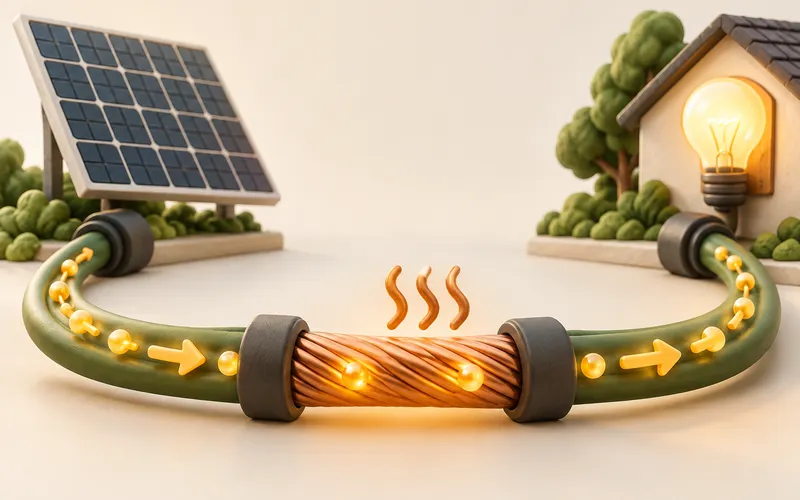
The calculation uses one-way cable length, resistance per kilometre for one conductor and a constant current. It doubles the length for equal outgoing and return conductors, then applies Ohm's law to estimate the voltage drop.

Enter conductor resistance appropriate to the cable and operating temperature. The initial value is illustrative, not a cable specification.

Why resistance and conditions matter

Resistance depends on conductor material, cross-section and temperature. Connections can add resistance, and the actual current and voltage can vary. This simple calculation does not include those effects or model an AC circuit.

The percentage compares the computed drop with the entered supply voltage. A calculated drop at or above the supply voltage shows that the constant-current assumptions are not physically consistent for the scenario.

A voltage drop is not a cable design

An acceptable-looking voltage drop does not establish cable current capacity, insulation suitability, protection, installation method or compliance with applicable rules. A cable can fail another requirement even when the arithmetic looks favourable.

This is an educational comparison, not a wire-size recommendation or an instruction to install equipment. Use a qualified electrician or designer and the relevant UK standards for a real system.

Before you rely on this

Calculate an illustrative voltage drop for two equal conductors in a constant-current DC loop.

  • The entered resistance is for one conductor at its operating temperature; both outward and return conductors are equal.
  • This does not select cable size, assess current capacity, protection or compliance, and is not an installation design.

Reference sources

Calculated results show their method version, assumptions and any data sources under "How this was calculated". Example starting figures are illustrations, not measurements.

Common questions

Why is the one-way cable length doubled?

The illustration assumes equal outgoing and return conductors, so current flows through both lengths.

Can this choose a cable size?

No. Voltage drop alone cannot establish current rating, installation method, protection, insulation or compliance. Use a qualified designer.

Is the starting resistance a recommended cable?

No. It is an illustrative value. Enter resistance appropriate to the actual conductor and operating temperature.

Does this apply to an AC circuit?

No. It is a simplified constant-current DC loop and does not model AC reactance or phase relationships.