Solar on a new build: what the developer fitted
Often a minimum-compliance system. How to tell whether it was sized for you or for the regulations, what the 2027 rules change, and when extending pays.
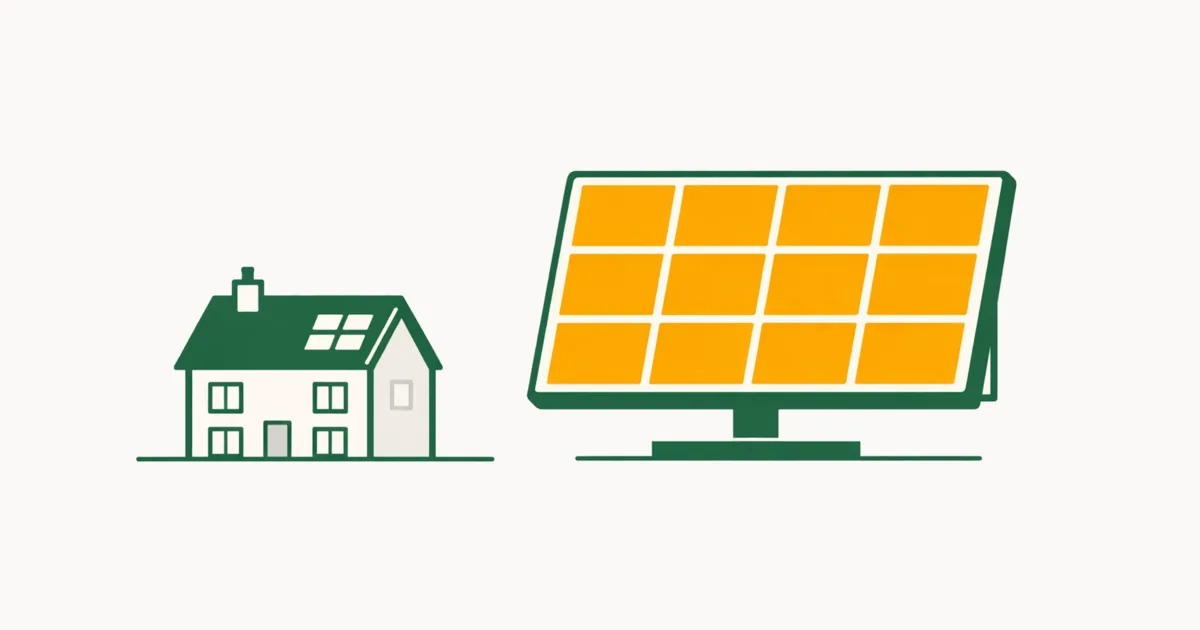
Panels fitted by a developer are usually sized to satisfy building regulations rather than to suit the household that will live there. That is not a scandal, it is what the regulations ask for, and it means the array on your new roof may be considerably smaller than the roof could carry.
Working out which you have takes ten minutes, and two of the checks are worth money in the first month.
Why they are often small
Building regulations set targets for a dwelling’s modelled energy use and emissions, and solar interacts with building regulations on any roof. On a new build under the current rules, though, solar is usually there because the compliance calculation wanted it. The government’s own impact assessment describes the 2021 reference home, the yardstick a design is compared against, as carrying solar panels only where it has no heat pump. Solar is one of several ways to hit the target, and a developer will fit the cheapest combination that passes.
That means the array is sized against a calculation using standard assumptions about occupancy and consumption, not against your actual household, the same standardised-household logic that shapes EPCs. If you have an electric car, work from home, or simply use more electricity than the standard assumption, the system was not sized for you. It also means the developer had no reason to fit one panel more than the calculation required.
What changes in 2027, in England
The rules are about to move from “solar if it helps the sum” to “solar by default”. The Ministry of Housing, Communities and Local Government’s March 2026 response on the Future Homes and Buildings Standards sets it out:
| Rule | What the response says |
|---|---|
| In force | 24 March 2027, for building that is not a higher-risk building, subject to transitional provisions |
| Transition | Building to the previous Part L needs documents submitted by 24 March 2027 and construction started by 24 March 2028 |
| The requirement | A new legal requirement to install a system for renewable electricity when a dwelling is built, on the building or within its curtilage, available for use by residents |
| How it is met | The Approved Document says panels covering the equivalent of 40% of each dwelling’s ground floor area meet it; lower coverage is accepted where the roof design prevents it |
| The floor | If the available roof cannot produce 720 kWh a year, no panels are needed; the response calls that “roughly equivalent to less than 2 PV panels” |
| Exemption | Buildings with a storey 18 metres or more above ground that contain dwellings |
The 40% figure is coverage, not capacity, and the final impact assessment converts it with an assumed 4.5 square metres of panel per kilowatt peak. So a home completed under the new standard will usually arrive with a real array. It will still be sized to the floor plan, not to your consumption, and everything below still applies. These are England’s rules; Scotland, Wales and Northern Ireland set their own.
A worked household: the 2028 semi
A semi-detached house of 84 square metres, the impact assessment’s own floor area for that house type, built to the new standard. Assume, for illustration, two equal storeys: a 42 square metre ground floor.
- 40% coverage is about 16.8 square metres of panel.
- At 4.5 square metres per kilowatt peak, about 3.7 kW.
- At the site model’s 850 kWh per kilowatt for a south facing roof, about 3,170 kWh a year.
- Half used at home at the October to December 2026 cap of 26.32p, half exported at Octopus Outgoing’s 12p: about £607 a year in today’s money.
- Of that, about £190 is export income, about £16 a month, and it is only paid once someone applies for it.
For scale, the impact assessment costs a roof-mounted system under 4 kW at £1,219 per installation plus £696 per kilowatt peak, in 2025 prices: about £3,820 for this array. That is the developer’s cost on a site, not a retail price, and it is inside what you paid for the house. The panels are not free; they were bought with the house.
Work out what you have
Find these in your handover pack, or ask the developer:
- System size in kWp. Panel count multiplied by panel wattage.
- Inverter make, model and rating.
- Estimated annual generation.
- The MCS certificate, without which the export step below fails.
- Whether an export tariff has been arranged.
That last one is worth checking in week one. A new-build array frequently sits exporting for free because nobody applied: registration is the owner’s job, it needs the certificate and a half-hourly meter, and every unregistered month is money handed to nobody: about £16 a month on the 2028 semi, and even a small 1.5 kW array exporting half its 1,275 kWh gives up about £6 a month at 12p. The Smart Export Guarantee obliges larger suppliers to offer you a tariff, and the rate varies several fold between the open and conditional offers.
Then work out what the roof could carry
Look at the usable pitches facing between east and west through south, measure them as you would for any sizing exercise, subtract the array already fitted, and see what area remains.
If there is significant unused south-facing roof, extending is worth pricing. If the array already covers the good slope, you have what you have, and the levers left are a diverter, load shifting or storage.
A second household: extending a small compliance array
A house finished in 2024 with an illustrative 1.5 kW array on a south slope that could take another 2.5 kW. The household uses 3,400 kWh a year.
- The extension’s price. As its own small job, at the DESNZ 2025/26 median of £1,780 per kilowatt for systems up to 4 kW: about £4,450, with no VAT on a qualifying installation until 31 March 2027.
- The extension’s output. About 2,125 kWh a year at 850 per kilowatt.
- The catch. The existing array already covers the easy daytime load, so less of the new output is used at home. At an illustrative 30% used: about 640 kWh at 26.32p, about £168, and about 1,490 kWh exported at 12p, about £179. About £346 a year, a payback of about 12.9 years.
- Against a fresh install. The same 2.5 kW with half used would earn about £407 and pay back in about 10.9 years. The difference is the share used, not the panels.
The widget starts on the extension; move the share used at home and the cost per kilowatt to your own quote.
- Import at 26.32p, the Ofgem price cap unit rate (Ofgem cap, 1 October to 31 December 2026).
- 850 kWh generated per kW a year, annual generation per kW, south facing (site model).
- Cost per kW starts at the DESNZ median installed cost per kW, 4 to 10 kW (2025/26 edition, published 28 May 2026, confirmed against the spreadsheet 2026-10-19): £1,697. The 0 to 4 kW median is £1,780.
- Year one only: no degradation, no inverter replacement, no standing charge, no battery.
Illustrative arithmetic on the inputs shown. For a projection with degradation, replacement and your tariff, use the calculator.
The extension also takes the house past a threshold: 1.5 kW plus 2.5 kW is 4 kW of panels, and if the inverter capacity rises above 3.68 kW the network connection becomes a G99 application rather than a notification.
Extending an existing array
Three things to check before assuming it is straightforward.
Inverter headroom. Can the existing inverter take more capacity? Inverters are rated, and a compliance-sized array often has an inverter sized tightly to it. If a larger inverter is needed, the economics change, and so may the grid connection route: above 3.68 kW of inverter is a G99 application, not a notification.
String compatibility. New panels should match the existing ones reasonably closely in electrical characteristics, or sit on their own string. Mixing mismatched panels on one string drags the whole string down. Panel models go out of production quickly, so ask what is available that matches, and expect the answer to be “a new string” more often than “more of the same”.
The network operator. Extending generation usually requires a further notification or application, and in constrained areas an export limit may apply.
An installer who says extending is trivial without checking those three has not checked them.
What the quote will say
Your new home comes with solar panels as standard, cutting your bills from day one.
True only once the export tariff is arranged, and only as far as the array is sized. Ask the sales office for the kilowatt peak, the panel count and wattage, the estimated annual generation, the MCS certificate number, and whether anyone has registered the export. On the 2028 semi the unregistered export is about £190 a year; on a small compliance array it is less, but it is never nothing.
The warranty question
Find out who warranties what, and for how long. On a new build there are three possible parties: the panel manufacturer, the installer the developer used, and the developer’s own warranty on the dwelling.
Establish which covers the array and for how long, and get it in writing while the developer is still responsive. This becomes much harder once the site is finished and the sales office has closed.
Also check who to call when the inverter fails, because one replacement during the system’s life is the normal case. On new builds this is often unclear, and the answer is much easier to obtain in year one than in year eight.
Snagging the installation
Two things worth looking at while you still have a snagging route:
From the ground: panels flush and evenly spaced, no cabling visible on the outside of the roof, tiles properly reseated around the brackets.
In the loft: cabling clipped rather than draped, the inverter accessible and somewhere that does not overheat, isolators labelled.
A compliance-driven installation on a busy site is exactly where corners get cut, and the snagging period is your leverage. Water ingress at mounting penetrations is the failure that matters; raise anything doubtful now, in writing, while fixing it is the developer’s problem.
Questions people ask
Do new build homes have to have solar panels?
In England, from 24 March 2027 under the Future Homes Standard, new homes need a renewable electricity system, and the guidance says panels covering 40% of the ground floor area meet it. There is a transition to 24 March 2028 for sites already submitted, an exemption for buildings with a storey of 18 metres or more, and no panels are required where the roof could not produce 720 kWh a year. Until then, panels appear where the compliance calculation needed them.
How big will the array be under the new rules?
It follows the floor plan. On the impact assessment’s 84 square metre semi, assumed to be two equal storeys, 40% of the ground floor at 4.5 square metres per kilowatt peak is about 3.7 kW, worth about £607 a year at the worked rates. A larger ground floor carries more; a complicated roof may justify less.
Can I add a battery to new build panels?
Usually. On a small compliance array there is little surplus to store, so the case rests mostly on charging from a cheap overnight tariff, and the battery has to be priced on its own. Whether the existing inverter can take one, or whether it needs an AC-coupled unit beside it, is the first question to ask.
Is it worth extending a new build array?
Price it as an increment. On the worked 2.5 kW extension, about £4,450 returns about £346 a year at 30% used, about 12.9 years, because the existing panels already cover the easy daytime load. Ask for the extension’s own line in the quote and the inverter position before deciding.
Check your own numbers
The array is there because the regulations required something, not because anyone modelled your household. Take the generation estimate, apply your own consumption and your own tariff, and see what it returns, then decide whether extending, adding a diverter or adding storage is worth doing, priced as increments against what the array already does. The calculator runs it in today’s money, with degradation and the inverter replacement in it. Start from the extended 4 kW roof and set your own usage: open the calculator with the worked example loaded.
Every step from survey to switch-on is collected in buying and installing solar panels. If you are still looking for businesses to quote, our installer directory lists Google’s listings near a postcode: Google data, so check MCS status yourself on the register.
Sources
- Ministry of Housing, Communities and Local Government, The Future Homes and Buildings Standards: 2023 consultation, summary of responses and government response, March 2026: in force 24 March 2027, the transition to 24 March 2028, the renewable electricity requirement, 40% of ground floor area, the 720 kWh floor, the 18 metre exemption. Checked 2026-10-20, gov.uk.
- Ministry of Housing, Communities and Local Government, Final stage impact assessment: Future Homes Standard: 4.5 square metres per kilowatt peak, the 2021 reference home’s solar only without a heat pump, 84 square metres for an end-terrace or semi-detached house, and roof-mounted PV at £1,219 per installation plus £696 per kWp (2025 prices). Checked 2026-10-20, gov.uk.
- Planning Portal, Solar panels and building regulations. Checked 2026-10-20, planningportal.co.uk.
- Department for Energy Security and Net Zero, Solar PV cost data, 2025/26 edition published 28 May 2026, median of £1,780 per kilowatt for systems up to 4 kW. Checked 2026-10-19, gov.uk.
- Ofgem, Smart Export Guarantee: the obligation on larger suppliers. Checked 2026-10-19, ofgem.gov.uk.
- Ofgem, Changes to the energy price cap between 1 October and 31 December 2026: 26.32p per kWh. Checked 2026-10-20, ofgem.gov.uk.
- Octopus Energy, Smart Export Guarantee: Outgoing at 12p. Checked 2026-10-19, octopus.energy.
- gowith.solar, What the calculator models, for the 850 kWh per kilowatt figure, what the calculator models.
- The two equal storeys, the 2024 house’s 1.5 kW array and 2.5 kW extension, the 30% and 50% shares and the quote box are illustrations, labelled as such.
Related
- How many solar panels do I need?Sized from your own consumption and usable roof area, not from bedroom count or a salesperson's default.
- The network operator application, explainedG98 notification against G99 permission, which applies to you, and what a refusal looks like.
- MCS certification: what it means and why it mattersWhat certification does and does not guarantee, why export payments depend on it, and how to check a registration properly.