Solar panel cost by house size: 2, 3 and 4 bedrooms
Bedrooms are a poor proxy for both roof area and electricity use. Here is what to size on instead, and how to get there from your own bill.
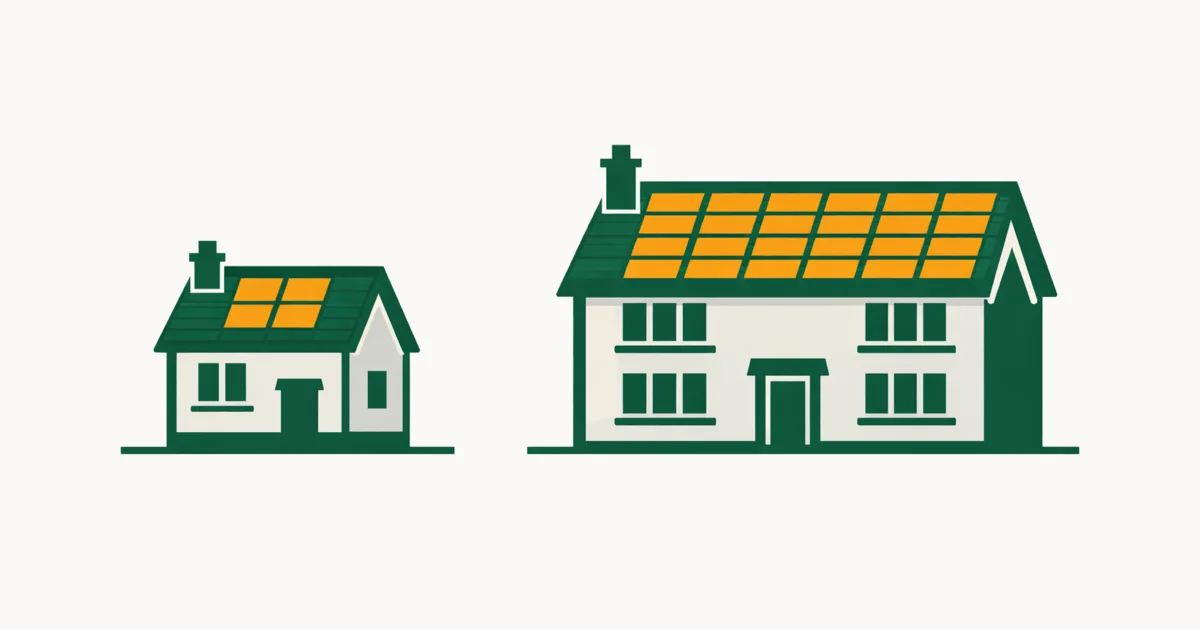
Search for solar prices and you will find tables organised by bedroom count. They are convenient, widely copied, and close to useless for deciding what to install on your house.
The reason is simple. A system is sized by two things: how much roof you have facing a useful direction, and how much electricity you use. Bedroom count is a weak proxy for the first and a very weak proxy for the second. What the tables are really doing is multiplying an assumed system size by a per kilowatt price, and you can do that yourself with better numbers: the government publishes the real per kilowatt costs, and your bill states your real consumption.
Why the bedroom table misleads
Consider two three bedroom houses.
The first is a Victorian terrace with a roof running north to south, so both pitches face east and west, one of them overshadowed by a taller neighbour. Two adults, both out at work, low daytime consumption.
The second is a 1990s detached house with a wide south facing rear pitch, an electric car, someone working from home, and a heat pump.
Same bedroom count. Completely different sensible systems, and a difference in worthwhile spend that is measured in multiples rather than percentages.
The prices behind the tables
Every bedroom table is a per kilowatt price wearing a costume, so start from the actual per kilowatt figures. The Department for Energy Security and Net Zero publishes cost data from real certified installations: for 2025/26 the median is £1,780 per kilowatt for systems up to 4kW, and £1,697 per kilowatt for systems between 4 and 10kW.
Applied to the sizes the tables usually assume:
- A small system of around 3kW prices near £5,300 at the small-band median.
- A 4kW system prices near £7,100, and what moves it either side of that is worth understanding.
- A larger 6kW system prices near £10,200, at the cheaper per kilowatt rate of the bigger band.
Those are medians of real installations, not quotes designed to start a conversation. Note what they imply: doubling the system size does not double the price, because the per kilowatt rate falls as the fixed costs spread. The right question is not “what does a three bed house pay” but “what size does my roof and usage justify, and what is that size worth per kilowatt”.
Size on roof area and orientation
What you can fit is a physical question:
- Identify which pitches face between roughly east and west through south. North facing pitches rarely earn their keep.
- Measure the usable area on those pitches, excluding chimneys, vents, roof windows and the margins installers must leave at the edges.
- Divide by the area of a modern panel to get a rough panel count. A current residential module such as LONGi’s Hi-MO X6 measures about 1.13 by 2.09 metres, roughly 2.4 square metres, and is rated around 540 watts.
- Multiply by panel wattage to get capacity.
A worked example: a rear pitch six metres wide with a four metre slope offers 24 square metres. Keep the edge margins and step around a roof window and perhaps 19 to 20 square metres remain, which is eight panels of that size, which is about 4.3kW. A satellite view and a tape measure get you this close; an installer’s survey will refine it.
Then size on consumption
What you should fit is a financial question, and it starts with your bill.
Find your annual consumption in kilowatt hours. It is on your annual statement, and your supplier’s app will have it. That single number tells you more about the right system than the number of bedrooms ever will, because self consumed generation is worth the import rate you avoid paying, currently 26.11p per kWh on the price cap, while exported generation earns an export tariff at a fraction of that.
Then ask when you use it. A household consuming a lot during daylight can usefully absorb a larger array. A household that is empty all day cannot, unless storage or a diverter is added to shift the surplus. If you have a smart meter, your supplier’s app can usually show half hourly usage, which answers the daytime question with data instead of guesswork.
What actually correlates with house size
Bedroom count is not entirely meaningless. It correlates loosely with:
- Occupancy, and therefore with daytime consumption, though working patterns swamp this.
- Roof area, though house age and shape matter far more.
- Heating and hot water demand, which matters if either is electric.
Loose correlation is exactly why the tables feel plausible and mislead anyway. They are right on average and wrong about your house.
A better three step estimate
Rather than looking up your bedroom count:
- Annual consumption from your bill, in kilowatt hours.
- Usable roof capacity from the measurement above, in kilowatts peak.
- Daytime share of your consumption, roughly, from your own routine or from half hourly smart meter data if you have it.
Those three tell you whether roof or usage is your binding constraint. If roof area is the limit, higher efficiency panels are worth paying for, because they are the only way to add capacity. If usage is the limit, storage or load shifting is the better spend, because extra panels would mostly export at the lower rate.
Cost still does not scale with size
Whatever size you land on, remember that scaffolding, certification and the site visit barely move with panel count. The official medians above show the result: the 4 to 10kW band is cheaper per kilowatt than the sub 4kW band, and the marginal panel on an already scaffolded roof is the cheapest capacity you will ever buy.
That is the argument against reflexively fitting the size the bedroom table suggested. If your roof and your consumption both support more, the extra capacity is the best value part of the whole job. The reverse also holds: paying for capacity your usage and export rate cannot justify is how oversized quotes happen, so check what is actually itemised in the quote before agreeing to a size.
Work it from your own numbers
Take your annual consumption, your usable roof capacity and your tariff, and model the result rather than looking it up. The calculator holds its assumptions steady while you change size, so you can see directly whether the step from 3kW to 4.3kW, or from 4.3kW to 6kW, pays for itself on your usage. The answer is specific to your house, which is precisely why the generic table could never have given it.
Related
- What a 4kW solar system actually costs in 2026The most common domestic size, priced from government installation data, with a worked savings example and the reasons the price band is wide.
- The cost of fitting solar panels: what is in the quote and what is notScaffolding, network applications, bird proofing, isolators. The line items that turn up late, and the ones a good quote states up front.
- What a 6kW solar system costs, and who it suitsA larger array priced against the 4kW default, and the consumption pattern that justifies the step up.