Solar iBoost+ against the eddi: two diverters on the same page, and how to measure what yours saves
Prices, load limits, sensors and warranties for the Solar iBoost+ and the eddi, plus how to measure what a diverter saves from your meter readings.
Explore this decision
Heat your water or export your surplus?
Surplus electricity has a value even when you do not buy it. Compare the heat it replaces with the export payment you give up.
Only count surplus the cylinder can use after other household demand and storage.
Explore this decision
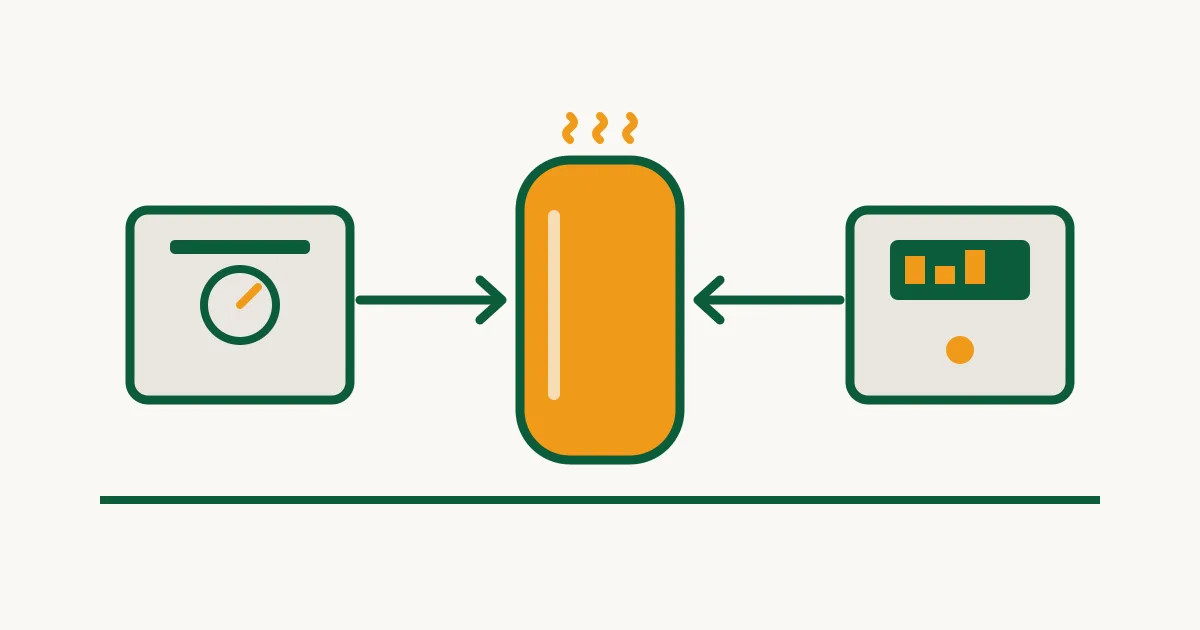
See how solar surplus heats a water cylinder
Connect water volume, temperature rise and electrical energy. The cutaway explains the parts; the calculation treats the entered volume as uniformly heated.
This is a sensible-heat illustration, without standing losses or stratification.
This is a spec-and-sum explainer, not a review. Every figure comes from the manufacturers’ own product pages or a UK retailer’s listing, as read on 25 October 2026; where a figure is not on those pages it is marked “Not stated”. The two devices do the same job, so the interesting part is not which has the longer feature list. It is how you would find out, from your own meter, whether either one is earning anything.
For what a diverter is and why a unit of hot water beats a unit exported, read the diverter explainer first. This article compares the two best known UK products and then spends most of its length on measurement.
The two products on their own pages
| Marlec Solar iBoost+ | myenergi eddi (single phase) | Checked | |
|---|---|---|---|
| Price | £329.99 including VAT, £274.99 excluding, at one UK retailer | From £439 “inc. VAT, if applicable”, on myenergi’s page | 2026-10-25 |
| Maximum load | 13 A resistive, “max 3 kW immersion” | 3.68 kW maximum heater load; 100 W minimum | 2026-10-25 |
| Operating voltage | 220 to 240 V AC | Not stated on the product page | 2026-10-25 |
| How it senses surplus | Wireless sender with a clamp at the meter, 868.3 MHz, 1 to 30 m indoors | Current transformer (CT) clamp with a 5 m cable as standard | 2026-10-25 |
| Sender battery | 2 AA cells; “up to 2 years” (Marlec), “about 1 year” (retailer) | Not applicable (wired CT) | 2026-10-25 |
| Boost | Push button, 15 minute steps, up to 2 hours | Boost timer; modes beyond that not specified on the page | 2026-10-25 |
| Monitoring | Screen shows savings for 24 hours, the previous day, a week, 28 days and in total; optional iBoost+ Buddy | Wi-Fi and the myenergi app, which lists diverted energy data and performance history graphs | 2026-10-25 |
| Other loads | Immersion | Immersion, storage heater, underfloor heating or any resistive load up to 3.68 kW with a thermostat | 2026-10-25 |
| Ingress protection | IP20 (controller) | Not stated | 2026-10-25 |
| Warranty | Not stated | 3 years | 2026-10-25 |
| Three phase | Not stated | eddi+ at £779, 0 to 9 kW | 2026-10-25 |
The prices come from different places on the same day: a retailer for the iBoost+ and the manufacturer for the eddi. They are not a like-for-like comparison, and a diverter fitted to an existing solar system is zero rated for VAT according to the diverter article, so the ex-VAT figure may be the relevant one for a quote. The gap on the as-listed prices is £109.01. At a net gain of 14.32p per diverted unit on electrically heated water (the sum below), that gap is paid back by about 760 diverted kWh, which is a sense of scale, not a verdict.
Three differences matter more than the price. The load: both handle the usual 3 kW immersion element, and the eddi’s extra 0.68 kW matters only if the element is bigger or the load is something other than a cylinder. The sensor: the iBoost+ is wireless, which helps when the meter is far from the cylinder and means a battery to replace; the eddi’s CT is wired, with a longer optional wireless sensor listed for runs beyond 5 m. And the warranty: myenergi states 3 years and Marlec’s pages read did not state any, which is a question for the installer, not an omission to assume away.
What a diverted unit earns
Each diverted unit is worth the price of the heat it replaces less the 12p export it gave up. With Octopus Outgoing’s 12p and the October to December 2026 cap of 26.32p:
- Electric immersion previously on grid power: 26.32p avoided less 12p forgone, 14.32p net a unit.
- Gas heated cylinder: the cap’s gas rate is 7.97p per kWh, including VAT. If the boiler turns 90% of that into heat, which is an assumption, a kWh of hot water costs about 8.86p. Diverting it saves 8.86p and forgoes 12p: about minus 3.1p a unit.
A full reheat is a physical number, not a price. A 150 litre cylinder heated from 10 to 55 degrees takes 150 times 4.186 kJ times 45, about 28,250 kJ, which is about 7.85 kWh, ignoring losses. Those temperatures and the cylinder size are illustrations; the 4.186 kJ per litre per degree is water’s specific heat. So even a generous summer’s day of surplus can only turn that cylinder into about 7.85 kWh of diverted units, worth about £1.12 on the electric sum above, and the ceiling falls as the cylinder warms.
The widget runs the shift from export to use on an array making 3,000 kWh a year; set the shifted kilowatt hours to what your device logs, below, and the value follows. As loaded, 600 kWh shifted is worth about £86 a year.
- Import at 26.32p, the Ofgem price cap unit rate (Ofgem cap, 1 October to 31 December 2026); export at the rate selected, from the Octopus SEG page (checked 2026-10-19).
- The gap between the two rates is 14.32p: what every kilowatt hour moved from export to use is worth. A 2p better export rate is the article's comparison, applied to the units still exported.
- Generation and the share used are yours to set; the shift is capped at what is exported. Year one, nothing inflated.
Illustrative arithmetic on the inputs shown. For a projection with degradation, replacement and your tariff, use the calculator.
How to measure what a diverter actually saves
A diverter’s own log says how much energy it sent to the cylinder. It does not say how many of those units would have been exported, or what they replaced. Three measurements together answer that: what you exported, what you generated, and what the water used to cost.
1. Choose two comparable periods. Fourteen days is enough in summer, when most of the surplus is. Compare a period without the diverter doing anything (the fortnight before it was fitted, or a fortnight with it switched off or scheduled out of the sunny hours: the myenergi app listing includes “pre-set when your eddi diverts surplus energy”) with a fortnight with it working. Pick weeks with similar weather, or use step 3.
2. Write down three meter readings each day, at the same time. Generation from the inverter or generation meter, export from the export register on the smart meter, and import. A smart meter shows the export register; your supplier’s app or the in-home display may too.
3. Compare shares, not totals. Divide export by generation for each period. A sunnier fortnight exports more kilowatt hours with no diverter at all, so the share is the fair test.
4. Cross-check with the device. The iBoost+ screen shows savings over 24 hours, the previous day, a week, 28 days and in total; the eddi’s app shows diverted energy and history graphs. If the device says 36 kWh and your meter says 37, you can believe both. If they disagree by half, the clamp may be on the wrong cable.
5. Convert at the right price. Multiply diverted kWh by 14.32p if the water was electric, or by about minus 3.1p if gas heated it. If gas did it, read the gas meter at the start and end of each period in summer, when the heating is off, and check the gas fell by about the diverted energy over your boiler’s efficiency.
A worked log (illustrative figures)
These readings are invented to show the method, not measured. Before the diverter: 14 days, 140 kWh generated, 70 kWh exported, a 50% export share. After: 14 days, 150 kWh generated, 38 kWh exported.
- Exported without a diverter at the old share: 150 times 50%, 75 kWh
- Exported with it: 38 kWh
- Diverted, by the meter: 75 less 38, 37 kWh. The device logged 36 kWh.
- On electric water: 37 times 14.32p, about £5.30 over the fortnight
- On gas water: 37 times minus 3.1p, about minus £1.16
At 37 kWh over 14 days the cylinder took about 2.6 kWh a day, roughly a third of the 7.85 kWh full reheat above, which fits a household whose cylinder was already warm and whose surplus was modest. The point of the example is the last two lines: the same device on the same roof earns about £5 over the fortnight on one household’s heating and costs about £1 on another’s.
What the quote will say
Solar diverter supplied and fitted. Saves you up to 60% on hot water.
“Up to” is the phrase to read. Ask what heats the water now, the cylinder’s size, and how many exported units the installer expects the cylinder to take. Ask for the VAT treatment on the line, and for the warranty in writing: myenergi states 3 years and the iBoost+ pages read did not. Marlec’s guide puts installation at “usually around £350 to £500” and does not say whether that includes the unit, so ask for the installed price as one line and the unit as another.
Questions people ask
What is the difference between an iBoost and an eddi?
Both divert surplus to an immersion heater. On the pages read, the iBoost+ is cheaper (£329.99 at a retailer against £439 from myenergi), handles 13 A resistive up to 3 kW on an immersion, and senses with a wireless clamp at the meter. The eddi handles 3.68 kW, can drive other resistive loads, uses a wired CT, has a 3 year stated warranty and reports to an app.
How do I know how much my solar diverter is saving?
Compare your export share, export divided by generation, over two similar fortnights, with and without the diverter, then price the difference at 14.32p a unit for electric water or about minus 3.1p for gas. Cross-check against the device’s own log, which counts diverted kWh but not what they replaced.
Does a diverter work without a smart meter?
The sensor is a clamp on your own cable, so the device works without one. The measurement above needs an export reading, which can come from a smart meter, a generation meter or the inverter’s own log; the fortnightly comparison is only as good as those readings.
Can I use an eddi or iBoost+ with a battery?
Marlec says the iBoost+ cut-in threshold can be raised so that some energy goes to a battery first. The eddi page read does not describe battery priority; the myenergi app listing mentions prioritising where surplus generation goes among its devices.
Check your own numbers
The device gives the diverted units; your hot water and your tariff give the value. The calculator takes your array, usage and tariff, in today’s money. Start from a 4 kW array and see what a 14.32p gain per diverted unit does to your payback: model the diverter by raising the share used at home, then compare with your measured fortnight: open the calculator with the worked example loaded.
See also the site’s price listing for one maker: myenergi product prices. It does not carry a page for Marlec.
Sources
- myenergi, eddi product page: from £439 including VAT if applicable, 3.68 kW maximum heater load, 100 W minimum, 3 year warranty, CT clamp with 5 m cable, boost timer. Checked 2026-10-25, myenergi.com.
- myenergi, shop page: eddi+ three phase at £779, 0 to 9 kW. Checked 2026-10-25, myenergi.com.
- myenergi, app feature sheet, July 2023: diverted energy data, device performance history graphs, pre-set diverting times. Checked 2026-10-25, support.myenergi.com.
- Marlec, Solar iBoost+ specifications: 13 A resistive, 3 kW immersion, 220 to 240 V, IP20, wireless sender, 15 minute boost steps, sender 2 AA cells up to 2 years; warranty and price not stated. Checked 2026-10-25, marlec.co.uk.
- Marlec, How do solar panels work with a Solar iBoost: sender at the meter, battery priority threshold, savings screen periods, installation “usually around £350 to £500”. Checked 2026-10-25, marlec.co.uk.
- Plug-In Solar, Solar iBoost+ listing: £274.99 excluding VAT, £329.99 including, sender about 1 year battery life. Checked 2026-10-25, pluginsolar.co.uk.
- Octopus Energy, Smart Export Guarantee: Outgoing at 12p. Checked 2026-10-25, octopus.energy.
- Ofgem, Changes to the energy price cap between 1 October and 31 December 2026: electricity 26.32p and gas 7.97p per kWh. Checked 2026-10-25, ofgem.gov.uk.
- The 150 litre cylinder, 10 and 55 degrees, the 90% boiler efficiency and the fortnight of readings are illustrations, labelled as such; the specific heat of water, 4.186 kJ per litre per degree, is a physical constant.
Related
- Solar diverters: turning surplus into hot waterA cheap way to raise self-consumption without a battery, and when it beats one.
- Solar hot water against solar electricityTwo different technologies sold with one word. Which one suits a British house now.
- Why your export rate matters less than your self-consumptionA unit you use is worth several times a unit you sell. Everything sensible about running a solar system follows from that one fact.