Solar diverters: turning surplus into hot water
A cheap way to raise self-consumption without a battery, and when it beats one.
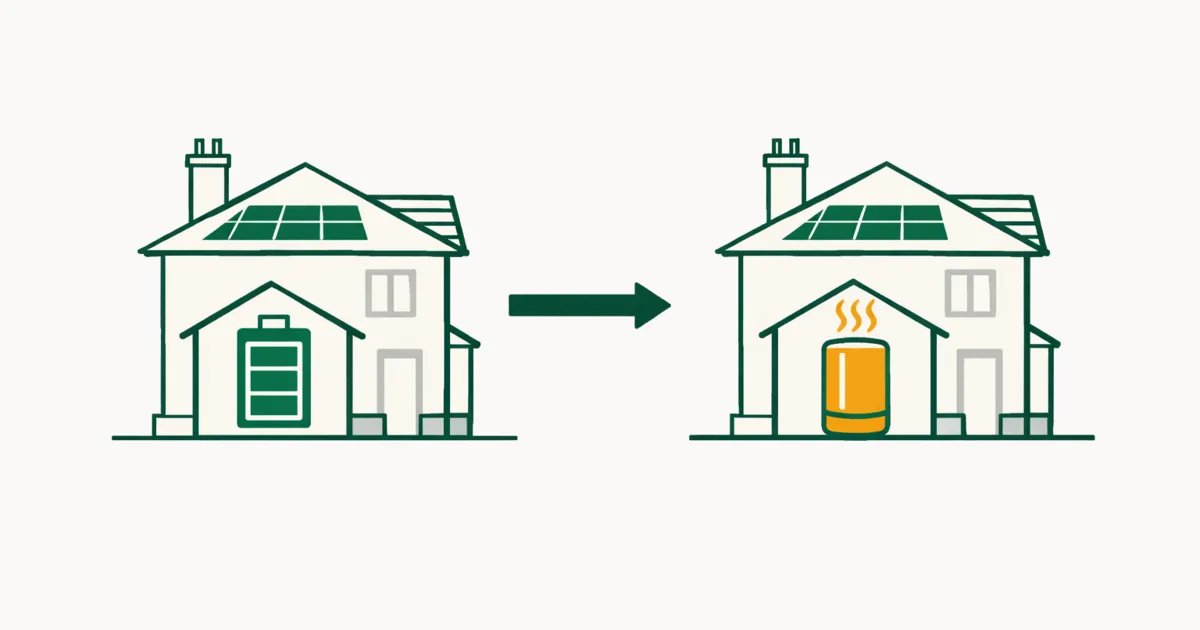
A solar diverter watches what your panels are generating and what your house is using, and sends the difference to your immersion heater instead of exporting it. It is the cheapest meaningful way to raise self-consumption, and for many households it beats a battery on return per pound.
The logic is the same as storage: a unit you use is worth more than a unit you sell. A diverter just stores it as hot water rather than as electricity, at a tenth of the price and with nothing inside it to wear out.
What it does, precisely
Without one, surplus generation flows to the grid and earns your export rate, 12p per kilowatt hour on a decent tariff.
With one, that surplus is diverted to the immersion heater until the cylinder reaches temperature. Once it is hot, the diverter stops and the surplus goes to the grid as normal.
It modulates rather than switching. Immersion heaters typically draw three kilowatts; a diverter feeds them whatever surplus exists at that moment, so it works with two hundred watts of surplus as well as with three thousand. That modulation is the whole trick: a plain timer on the immersion would drag imported electricity in alongside the surplus, while the diverter takes only what would otherwise have left the house.
The value per unit, worked
Each diverted unit is worth the difference between what you would otherwise have paid to heat that water, and the export rate you gave up.
Electrically heated water: you avoid the capped import rate of 26.11p and forgo 12p of export, a net gain around 14p per unit. A household diverting 1,000 kilowatt hours a year gains roughly £140, which pays back a device costing a few hundred pounds installed in two to three years, faster than almost anything else in home energy.
Gas heated water: the diverted unit displaces gas at a much lower price per kilowatt hour of heat, so the net gain per unit shrinks to a few pence, and on a good export tariff simply exporting can be the better use of the same units. It can still pay, but run the sum with your actual gas rate rather than assuming.
One more line for the ledger: a diverter retrofitted to a solar system is itself zero rated for VAT, named explicitly in the HMRC rules from 1 February 2024, so the quote for one should carry no VAT either.
What you need
Three things:
An immersion heater. A hot water cylinder with an electric element. Combi boiler households have no cylinder and no immersion, so a diverter has nothing to divert to, which quietly excludes a large share of UK homes before the arithmetic starts.
Surplus to divert. If you already consume nearly everything you generate, there is little to capture. Your smart meter export figure tells you exactly how much there is.
A sensible cylinder. Well insulated, and ideally large enough to absorb a summer afternoon’s surplus without reaching temperature by lunchtime.
Against a battery
They solve the same problem at very different price points.
A diverter costs a fraction of a battery, has essentially nothing to go wrong, and needs no maintenance. It converts surplus into hot water, which is useful but not flexible: it cannot run your lights.
A battery costs thousands, degrades, and will eventually need replacing. It converts surplus into electricity you can use for anything, including the evening peak, at roughly 10.7p of net gain per cycled unit on current rates.
Notice the comparison that follows: per unit captured, the diverter’s 14p on electrically heated water beats the battery’s 10.7p, at a twentieth of the capital. The sensible order for most households is diverter first, battery later. The diverter takes the cheapest available bite out of your exported surplus, and whatever remains is what a battery would have to justify itself against.
If you are considering both, model the battery on the surplus that would remain after the diverter, not on your current export volume. Doing otherwise double-counts the same units, and it is exactly how a package quote’s battery projection gets flattered.
The summer ceiling
The honest limitation: in high summer the cylinder is often up to temperature by early afternoon, and the diverter stops. Beyond that point the surplus is exported as it always was.
This is why a diverter does not remove the case for storage in a household with a large array. It caps out at your hot water demand, a few kilowatt hours a day, and it caps out exactly when you have most surplus. The battery’s advantage is that its ceiling is electrical demand generally, which is larger.
Practical points
- Legionella. A cylinder heated only by surplus may not reach a high enough temperature regularly. Keep the boiler or timer cycle that periodically heats it fully; the diverter is a supplement, not a replacement for proper cylinder hygiene.
- Placement. Most units fit near the consumer unit with a clamp on the incoming supply. It is an electrician’s hour, not a scaffolding job.
- Export payments. Diverting reduces exported units, so export income falls. That is intended: you are converting low-value exports into higher-value avoided imports, and the net is positive whenever the value gap above is.
Work out your own figure
Take your annual exported units from your smart meter data, estimate what share falls in periods when your cylinder would not already be hot, and multiply by the gap between your water heating cost and your export rate. Compare that against the installed cost, and put the resulting self-consumption improvement through the ROI calculator if you want to see it inside the whole system’s payback. For most households with a cylinder, the answer comes back quickly, and it is usually yes.
Related
- Why your export rate matters less than your self-consumptionA unit you use is worth several times a unit you sell. Everything sensible about running a solar system follows from that one fact.
- Solar hot water against solar electricityTwo different technologies sold with one word. Which one suits a British house now.
- Solar roof tiles against conventional panelsBetter looking, more expensive, less efficient per square metre. When that trade is worth making.