Installing a home EV charger: cost and requirements
Supply capacity, notification and the survey question that decides whether it is straightforward.
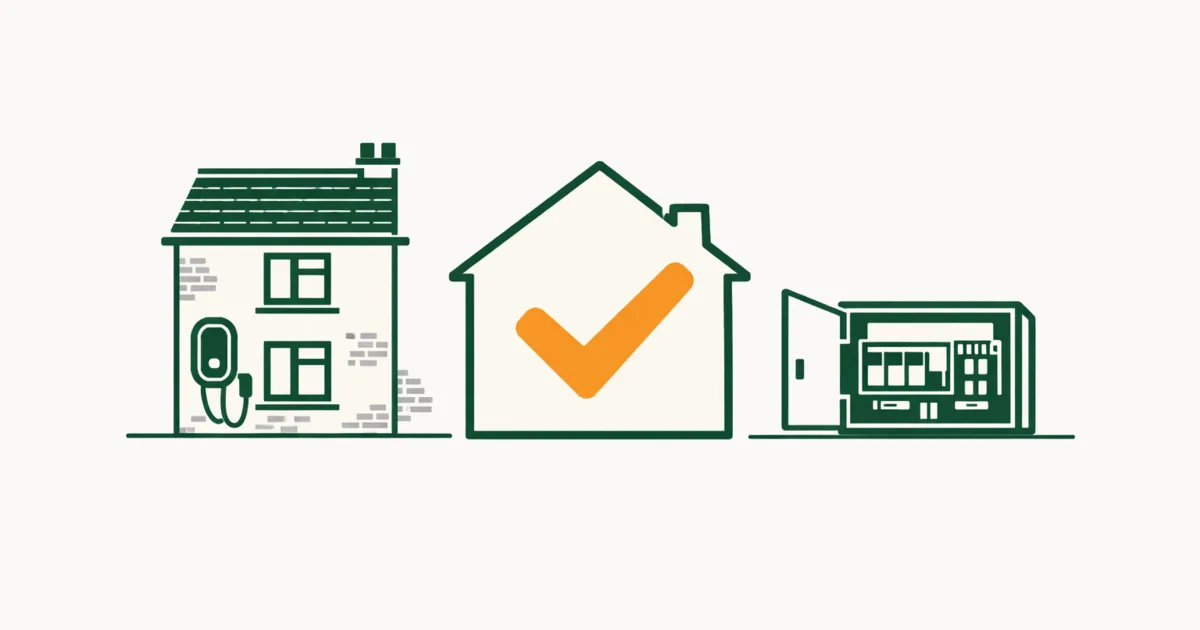
Fitting a home charger is a half-day job for an electrician, and the variable that decides whether it is straightforward is your incoming supply rather than the charger itself.
Establish that first, because it is the thing that turns a routine installation into an expensive one, and it is checkable before anyone quotes.
What gets installed
A wall-mounted unit, typically seven kilowatts on a single-phase supply, on its own dedicated circuit from your consumer unit, with appropriate protection and an isolator.
Most units also need a current clamp fitted on your incoming supply so the charger can see total household demand. That clamp is what makes load balancing and solar matching possible, so make sure it is included rather than treated as an optional extra: it is a few pounds of hardware that unlocks the two most useful behaviours the charger has.
The supply question
Your house has a main fuse with a rating, commonly 60, 80 or 100 amps, and everything in the property draws through it. Adding seven kilowatts, roughly 30 amps, of continuous load is significant: alongside an electric shower and an oven, an unmanaged charger can push a smaller main fuse past its rating.
Three possible outcomes:
Enough capacity. The common case, particularly on a 100 amp fuse. The charger is added and nothing else changes.
Enough capacity with load balancing. The charger monitors total demand and reduces its draw when the house is busy, so the main fuse is never at risk. This is normal, sensible and should be standard rather than an upsell. The consequence is that charging slows when the oven and the shower are on, which overnight charging never notices.
Not enough capacity. A supply upgrade is needed, arranged through the network operator. This is the expensive and slow outcome, and it is why the survey matters.
Your installer should establish which applies before quoting. Ask what your main fuse rating is and what they intend to do about it, and treat an installer who did not ask as one quoting a template.
Notification
The installation is notified to the local network operator through the same connection framework that covers home generation. For a standard domestic charger this is a notification rather than an application for permission, though smart chargers and larger or three-phase setups can involve more.
Your installer handles it. Confirm it has been done, because it matters if you later add solar or storage and the network needs an accurate picture of what is connected at your property.
Where to put it
Practical considerations that are easy to get wrong:
Cable reach. Where does the car actually park, and which side is its charging port? A tethered cable that will not reach round the car is a daily irritation, and port position varies enough between cars that a future car is worth a thought too.
Cable run length. The distance from your consumer unit to the charger drives cost. A charger on the far side of the house from the board is more expensive, for the same reason long cable runs appear in solar quotes.
Weather and height. Units are weatherproof, but a sheltered position is kinder. Mount it at a height where the cable is not dragging on the ground.
Trip hazards. If the cable crosses a path, think about where it will lie.
What to ask before booking
- What is my main fuse rating, and does this need an upgrade?
- Is load balancing included, and is the clamp fitted as standard?
- Does the unit support solar matching, if I have or plan panels, and does my tariff pair actually reward using it?
- What happens if the internet connection drops? Some chargers refuse to start a smart session; better ones fall back to a stored schedule.
- Where will the isolator be?
- Is the notification to the network operator included?
That fourth question deserves pressing, because the charger’s scheduling is what converts a cheap overnight window into 2p-a-mile motoring. A charger that will not operate offline is one bad router week from charging your car at 26.11p instead of 8p, and it is not something you discover until it happens.
Grants
The broad domestic grant that once covered most owner-occupied houses has closed. What remains is targeted: the EV chargepoint grant gives renters and flat owners 75% off the cost of buying and installing a chargepoint, up to £500, with a separate route for landlords.
If you are in a house you own, budget on no grant. If you rent or own a flat with off-street parking, the grant is real and worth the paperwork; check the eligibility detail on the official page rather than a summary, including this one.
If you also have solar
Install both together where you can. One contractor coordinating the electrical work avoids a second visit and a second set of consumer unit changes, and the clamp on your supply serves both the charger and the solar monitoring.
If solar is coming later, tell the charger installer. Leaving room in the consumer unit and choosing a charger that supports solar matching costs nothing now and saves replacing the unit later. Then, when both are in, put the whole household through the ROI calculator with the EV option on: the charger is the cheap component, and the tariff and timing decisions around it are where the actual money moves.
Related
- What charging an EV at home actually costsPence per mile on each common tariff, against public rapid charging, worked from figures you can read off your own car and bill.
- Charging your EV from solar: how much you can actually useWhy a 7kW charger and a 4kW array rarely meet, and the three things that close the gap between generation and when the car is plugged in.
- Choosing a home EV chargerScheduling and solar-matching are the two features that change what you pay. The rest is styling.