EV charging at home
What charging at home really costs against public rapid charging, and what an electric car does to the case for solar and a battery.
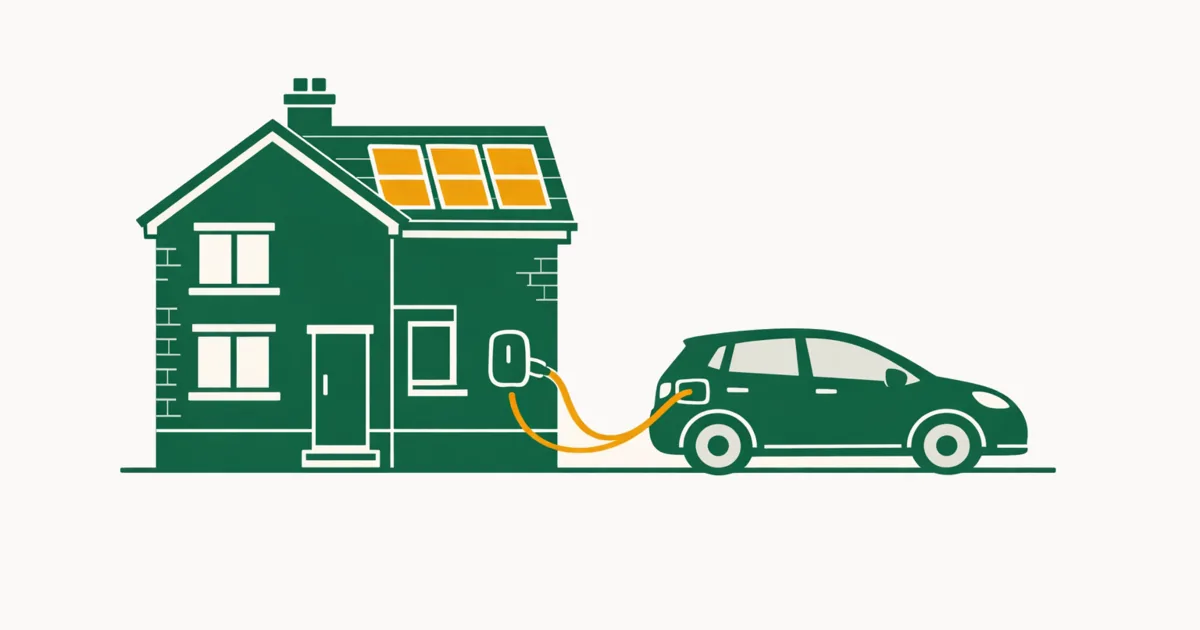
Charging at home is normally far cheaper than charging in public, and the gap is wide enough that it changes what a car costs to run. It also changes the case for solar, though not in the way most people assume.
This hub covers the cost per mile arithmetic, the tariff choice that dominates it, and the awkward truth about charging an electric car from your own panels.
Cost per mile, worked from your own figures
The calculation is simple and you can do it for any tariff:
- Find your car’s real world efficiency, in miles per kilowatt hour. The trip computer will give you an average; expect it to be worse in winter.
- Take the unit rate you would pay when charging, in pence per kilowatt hour.
- Divide the rate by the efficiency. That is your pence per mile.
Do it twice, once with your standard rate and once with an off peak rate, and the value of a time of use tariff becomes obvious immediately. Then do it a third time with a public rapid charging rate for comparison.
The difference between charging overnight at home on an off peak rate and charging at a public rapid unit is the single largest running cost variable most electric car owners have.
The tariff matters more than the charger
Home chargers differ in features, app quality and looks. They differ much less in what they cost you to run, because that is set by your tariff.
Most electric vehicle tariffs work by offering a cheap window overnight, in exchange for a standard or slightly higher rate the rest of the time. Whether one suits you depends on:
- How much you drive, since the saving scales with units consumed.
- Whether you can shift other loads into the cheap window. A dishwasher and a washing machine on timers add to the benefit.
- What the daytime rate becomes, which is the cost side of the trade.
A household that drives very little can end up worse off on an EV tariff, because the higher daytime rate applies to all their other consumption.
Charging from solar is harder than it sounds
Here is the part that is usually skipped. A typical home charger draws around seven kilowatts. A typical domestic solar array is smaller than that, and only reaches its peak output in good conditions around the middle of the day.
So a car plugged in at 6pm and charging at full rate is running almost entirely on imported electricity, whatever the panels did earlier.
Three things narrow the gap:
Charge during the day where you can. If the car is home on weekdays, or at weekends, daytime charging uses generation directly.
Use a charger that can follow the solar output. Many chargers offer a mode that modulates the charge rate to match surplus generation, so the car takes what the panels are producing and no more. This raises self consumption considerably.
Add storage. A battery captures midday generation and releases it in the evening, which is when most cars are actually plugged in.
Without one of these, the overlap between generation and car charging is smaller than the sales material suggests.
An electric car changes the solar case, mostly for the better
An EV increases household electricity consumption substantially. Because the value of solar comes from displacing units you would otherwise import, more consumption means more opportunity to displace, provided the timing can be made to line up.
That is the important condition. An electric car improves the case for solar if you can move the charging into daylight or store the generation until the car is home. If neither is possible, the car mostly adds cheap overnight import, which is a good outcome in itself but not one the panels contributed to.
Installation practicalities
- Most home chargers are seven kilowatt units on a dedicated circuit.
- Installation usually requires notification to the network operator.
- A property with an older supply may need work before a charger can be fitted.
- If you are installing solar and a charger at the same time, having one contractor coordinate both avoids a second visit and a second set of electrical works.
Model the car and the panels together
Treating the car and the solar system as separate decisions produces the wrong answer, because the interaction between them is where most of the value sits. The calculator on this site takes EV charging as an input to the solar business case, so the effect of the extra demand and its timing shows up in the payback rather than being assumed away.
Everything in ev charging at home
- comparisonChoosing a home EV chargerScheduling and solar-matching are the two features that change what you pay. The rest is styling.
- referenceInstalling a home EV charger: cost and requirementsSupply capacity, notification and the survey question that decides whether it is straightforward.
- calculationWhich EV tariff is cheapest for your mileageThe cheap window is only worth what you put through it. Work it out from your own annual miles.
- patternCharging your EV from solar: how much you can actually useWhy a 7kW charger and a 4kW array rarely meet, and the three things that close the gap between generation and when the car is plugged in.
- calculationWhat charging an EV at home actually costsPence per mile on each common tariff, against public rapid charging, worked from figures you can read off your own car and bill.