Skip to content
gowith.solar

Solar charge controller calculator: compare voltage and current figures

Compare entered PV and battery-side figures with controller ratings.

Your situation

Illustrative battery-side output

An entered operating scenario, not a forecast or guaranteed maximum.

PV input figures

Enter a properly temperature-corrected figure from your designer.

Use the figure and correction method required by the manufacturer and designer.

Calculated from your figures

30 A illustrative output current

PV voltage margin
35 V
PV short-circuit current margin
3 A
Output current margin
0 A

What this means

An arithmetic comparison of entered figures, not a controller selection or safety check.

The working

The maths, step by step

illustrative output (A)=400×90÷100÷12=30\text{illustrative output (A)} = 400 \times 90 \div 100 \div 12 = 30
output rating margin (A)=30−30=0\text{output rating margin (A)} = 30 - 30 = 0
PV voltage margin (V)=100−65=35\text{PV voltage margin (V)} = 100 - 65 = 35
PV current margin (A)=15−12=3\text{PV current margin (A)} = 15 - 12 = 3

A negative margin means the entered figure exceeds the entered rating. A positive margin does not establish compatibility or safe operation.

Understand your result

A closer look at the calculation

The context behind the numbers, so you can decide what to check next.

Keep PV and battery-side figures separate

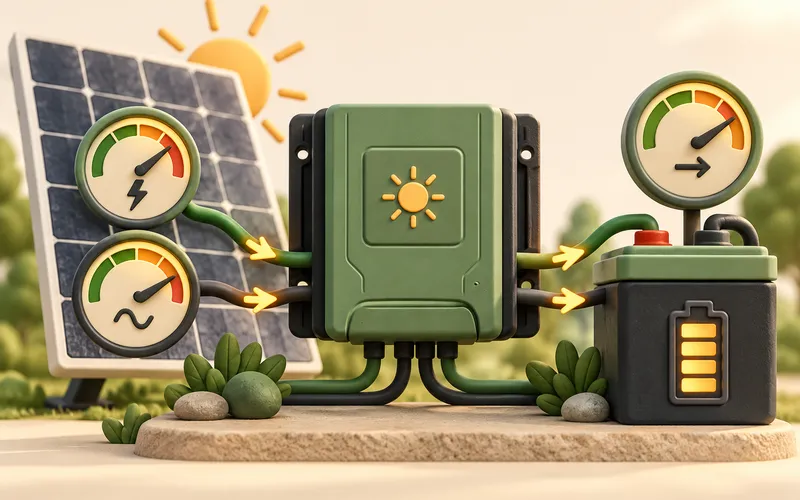
An MPPT charge controller can accept a higher PV voltage while charging a lower-voltage battery. The controller's maximum PV voltage, PV short-circuit current limit and battery output current rating describe different quantities and should not be interchanged.

The calculator compares the figures you enter. Starting values are examples, not a recommended equipment combination.

Illustrative output current

Multiplying available PV power by an assumed efficiency and dividing by an assumed battery charging voltage gives an illustrative output current before any controller limit. Real output depends on operating voltage, charging stage, available power and controller behaviour.

A controller may limit current. A negative arithmetic margin highlights an exceeded entered rating, but it does not by itself establish how a particular controller behaves or whether oversizing is permitted.

PV voltage and short-circuit current

Open-circuit voltage can rise in cold conditions. Enter the worst-case temperature-corrected array voltage established for the system, not just a single panel's room-temperature figure. Parallel strings and the manufacturer's requirements also matter for the current figure.

This page does not calculate the required correction factors or check minimum tracking voltage, conductor protection, battery acceptance, thermal derating or installation rules. A positive margin is not a pass or a safety certification.

Check the complete design

Consult the actual controller, panel and battery manuals and engage a qualified designer or installer. Different controllers specify PV input and output limits differently, and all applicable conditions must be met.

The tool cannot select a controller or establish electrical compatibility. Treat its output as arithmetic to discuss with the installer, not an installation instruction.

Take it further

Solar and battery ROI calculator

Would this battery earn its keep?

The ROI calculator adds a battery to a full solar projection: charging from surplus, cheap-rate tariffs, capacity fade and the replacement year.

Open the ROI calculator

Before you rely on this

Compare entered PV and battery-side figures with controller ratings.

  • All ratings and array figures are entered by the user; PV voltage must be corrected for worst-case temperature outside this tool.
  • Output current is an uncapped power-over-voltage illustration. Positive margins do not establish compatibility or safety.

Reference sources

Calculated results show their method version, assumptions and any data sources under "How this was calculated". Example starting figures are illustrations, not measurements.

Common questions

Does a positive margin mean the controller is suitable?

No. This compares only the entered figures and does not check all manufacturer requirements, electrical protection or installation conditions.

Why is PV voltage checked separately from output current?

They are different limits on different sides of a charge controller. An MPPT controller can use a higher PV voltage to charge a lower-voltage battery.

Does this correct open-circuit voltage for cold weather?

No. Enter the worst-case temperature-corrected array figure established by a qualified designer.

Does a negative output margin predict the actual current?

No. The calculated current is a power-over-voltage illustration before limits; real controller behaviour depends on the equipment and conditions.