Solar panel maintenance: what it actually needs
Cleaning, monitoring and inverter replacement, with realistic lifetime costs and the checks worth doing yourself each year.
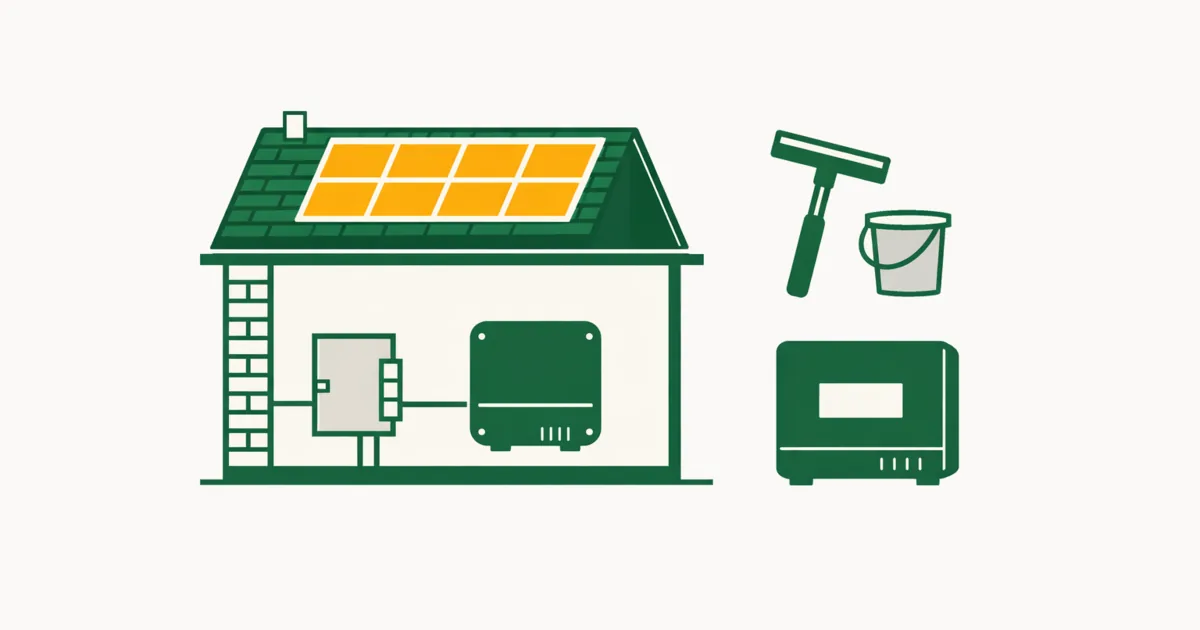
Solar panels have no moving parts, which is why maintenance is genuinely light. It is not nil, and the parts that do cost money are predictable enough to budget for.
The single most valuable maintenance activity costs nothing: looking at your generation figures often enough to notice when they change.
Monitoring is the real maintenance
Most systems come with monitoring, through an app or a web portal. Use it.
A solar system fails quietly. There is no noise, no smell and no visible sign; a string simply stops producing, or produces less, and the first indication is a number nobody was looking at. Faults have run for months before anyone noticed, and the cost of not noticing is easy to put a figure on: half of a 4kW system silent through three bright months is roughly 600 kilowatt hours of lost generation, which at the current capped import rate of 26.11p and a 12p export rate is somewhere between £70 and £150 of value, depending on how much you would have self consumed. A monthly glance at an app is well paid work.
What to do, once a month:
- Check the system is producing at all.
- Compare this month against the same month last year. Allow for weather, but a large unexplained drop is worth investigating.
- If your system reports per panel or per string data, look for one lagging the others.
That is the whole routine, and it catches most of what goes wrong.
Cleaning
Panels are glass at a pitch in a rainy climate, so they largely clean themselves. Rain removes most general dust and pollen.
Cleaning becomes worthwhile when something rain does not shift accumulates:
- Bird droppings, which are opaque and can sit on one cell. On a plain string inverter one badly fouled panel drags the whole string, so a single deposit can cost far more than its area suggests.
- Lichen or moss creeping in from the roof edges.
- Sap and leaf debris under trees.
- Persistent grime on shallow pitches, where rain runs off more slowly.
A shallow pitch collects more than a steep one. If you are under trees or near a busy road, expect to need it more often.
If you have it done, use someone insured for work at height and using appropriate equipment and water. Abrasives and harsh chemicals damage the coating on the glass, and a scratched coating is permanent in a way dirt never was.
Bird proofing
Pigeons nest in the gap between panels and roof. The result is mess, blocked airflow and sometimes damaged cabling.
Mesh around the array perimeter prevents it. It is far cheaper fitted at installation, when the scaffolding is already up, than retrofitted later, when the scaffold must be hired again for a job that takes an hour. If you are still at quote stage, ask about it now.
The inverter is the real cost
This is the maintenance item that matters financially.
Inverter design life is shorter than panel design life, so expect at least one replacement during the system’s life, typically somewhere in the middle of it. Plan for it, and make sure any long projection you are shown includes it: our calculator places one mid-projection for exactly this reason, and a savings table without one is quietly overstating the later years.
Signs one is nearing the end: repeated fault codes, unexplained shutdowns, reduced output with no corresponding change in conditions, or unusual noise.
Panel degradation is not a fault
Output falls slowly and steadily as panels age, a fraction of a percent a year. This is expected and warranted: manufacturers publish performance warranties guaranteeing a remaining output percentage after twenty five years, LONGi’s product pages show the pattern, precisely because the decline is known and bounded.
The distinction to hold onto: a gradual reduction over many years is normal and already priced into an honest projection. A sudden drop is not, and is worth investigating the week you notice it, not the year.
An annual visual check
From the ground, with binoculars if needed. Never go onto the roof yourself.
- Panels sitting flat and square, with no visible movement.
- No cracked or discoloured glass.
- No nesting under the array.
- No cabling hanging loose or chafing.
- Nothing new shading the array, particularly vegetation that has grown.
That last one accumulates invisibly. A tree that was not a problem when the system went in can become one over several summers, and shading erodes output in the same quiet way a fault does, which is why the monitoring comparison against last year matters: it catches growth as well as breakage.
Budgeting realistically
Over a typical system’s life, expect:
- Occasional cleaning, depending on pitch and surroundings.
- At least one inverter replacement.
- Possible bird proofing, if not fitted at installation.
- A battery replacement, if storage is fitted and your projection runs long enough, with capacity declining on the way there.
Put these in the projection at the years you expect them. A savings table with no costs in it after year one is not describing a real system, and the omission always flatters the result. The system that pays back honestly is the one whose owner glanced at an app once a month and budgeted for one box swap in year twelve; nothing about that is onerous, which is the fair summary of solar maintenance.
Related
- Solar inverters explained: string, hybrid and microWhat the inverter decides, when paying more for one changes the return, and the question that settles which type your roof needs.
- Solar panel payback period: how to calculate it properlyWhy the headline figure on a quote is usually optimistic, and the arithmetic that corrects it without pretending to more precision than exists.
- Solar roof tiles against conventional panelsBetter looking, more expensive, less efficient per square metre. When that trade is worth making.