Are solar panels worth it in Wales?
Generation, grants and housing stock, and where the Welsh answer differs from the English one.
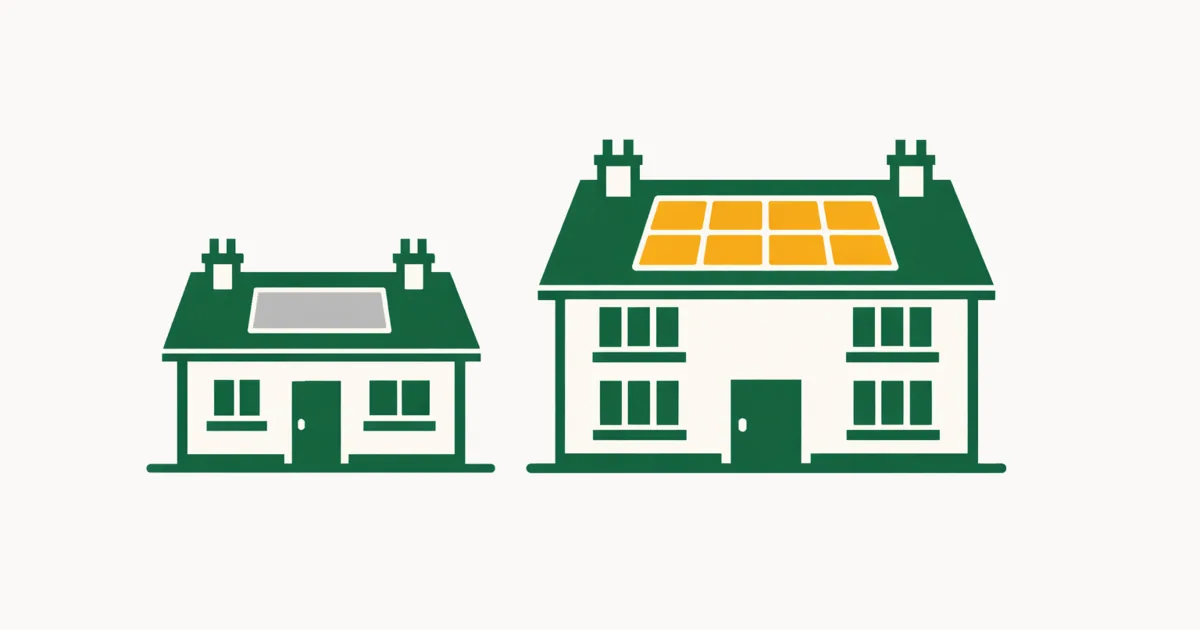
Yes for many Welsh homes, and the answer turns on the same four inputs as anywhere: consumption, roof, tariff and how long you will stay. What differs is a funding scheme that, unusually, still lists solar; an installation market that is among Britain’s cheapest; and a generation figure that varies more within Wales than most people expect.
The Welsh price advantage
Start with the half nobody mentions. The government’s regional cost data puts the 2025/26 mean for Welsh systems up to 4kW at £1,951 per kilowatt, against £2,177 in London and the South West: roughly £900 less on a 4kW system than the dearest English regions, on a sample of over 22,000 Welsh installations in the year.
Worked through at Welsh prices: a 4kW system at about £7,800, generating say 3,300 kilowatt hours on a decent South Wales roof, saves a household self consuming half around £632 a year at the October to December 2026 cap of 26.32p and Octopus Outgoing at 12p: a payback a little over twelve years, within touching distance of the standard English example, and every lever that moves one moves the other.
Generation across Wales
Wales spans a wide range of conditions. Southern coastal areas receive noticeably more solar energy across the year than inland upland regions, and the west is generally wetter than the east.
Terrain matters here more than in flatter parts of Britain. A property in a valley may lose meaningful morning or afternoon sun to the hillside opposite, and that is shading a satellite view will not show you. The European Commission’s PVGIS tool can include terrain horizon shading in its free postcode estimate, which makes it particularly useful in Wales.
Two practical instructions: insist on a postcode-specific generation estimate and ask which tool produced it, and photograph your roof at three or four points across a day, ideally in winter when the sun is lowest, and give those to the installer.
The housing stock
Wales has a large proportion of older, solid-walled properties, and that affects this in two ways.
Sequencing. For a poorly insulated solid-walled house, fabric measures usually deliver more per pound than generation. Insulation and draughtproofing have no orientation requirement, no inverter to replace and no export rate to worry about. Funding schemes reflect that in what they will fund, and it is sound advice regardless.
Roof work. Slate is common and is slower and more fragile than concrete tile. Expect higher labour and some breakage, expect a competent installer to say so up front, and treat it as one of the legitimate reasons quotes differ rather than as padding.
Traditional construction may also raise questions about roof loading and fixing into older timbers. That is what the survey is for.
Planning
Wales has its own planning regime, and permitted development conditions are not identical to England’s, so check Welsh guidance rather than the English figures. The familiar exceptions all apply:
- Listed buildings, where consent is a separate and stricter question.
- Conservation areas, where restrictions commonly apply to elevations fronting a highway.
- Flat roofs, where the mounting frame raises the panels above the roof plane.
Wales has a significant number of listed buildings and conservation areas. Confirm the position with your local planning authority before ordering equipment.
Funding
Wales is currently the standout. The Welsh Government’s Nest scheme provides free, impartial advice and funded improvements to eligible households, and its own list of measures names solar panels alongside heat pumps and insulation, which neither Scotland’s scheme nor anything in Northern Ireland can say. Eligibility is means and property tested, and the scheme decides the package, usually fabric first.
Alongside that, GB-wide support applies: ECO4 runs to 31 December 2026 for eligible households, and the VAT zero rate runs to 31 March 2027 for everyone, applied inside the quote with no means test. On the £7,800 worked system it is worth £390 against the 5% reduced rate that returns on 1 April 2027, so a Welsh household deciding this winter has a deadline in the sum as well as in the calendar.
Two Welsh houses, two answers
The range inside Wales is wide enough to show with the same system on two roofs. A south-facing semi in Cardiff, postcode estimate 3,300 kilowatt hours from 4kW, half self-consumed: the worked £632 a year and a payback a little over twelve years. The same array on a valley-floor terrace near Merthyr, east-west pitches and a hillside stealing the late afternoon, might come back from PVGIS at 2,600 kilowatt hours: roughly £500 a year on the same shares, and payback stretching past fifteen years.
The two houses on the same axes
Both rows use the same 4kW system at £1,950 per kilowatt, half the generation used in the home, the 26.32p cap on what is used and Outgoing at 12p on what is exported. Only the roof changes. Both generation figures are illustrations of what a postcode estimate might return, not measurements.
| Cardiff semi, south | Valley terrace, east-west and shaded | |
|---|---|---|
| Installed cost | £7,800 | £7,800 |
| Generation a year | 3,300 kWh | 2,600 kWh |
| Used in the home | 1,650 kWh, £434 | 1,300 kWh, £342 |
| Exported at 12p | 1,650 kWh, £198 | 1,300 kWh, £156 |
| Saving a year, today’s money | £632 | £498 |
| Simple payback | 12.3 years | 15.7 years |
| On the open 4.1p SEG rate instead | £502, 15.5 years | £395, 19.7 years |
The widget starts on the Cardiff row. Drop the generation by moving the system size, or change the export tariff, and watch how far a valley roof on an open export rate drifts from the headline.
- Import at 26.32p, the Ofgem price cap unit rate (Ofgem cap, 1 October to 31 December 2026).
- 825 kWh generated per kW a year, the article's illustrative postcode estimate rather than the site model's 850 kWh.
- Cost per kW starts at the DESNZ median installed cost per kW, 4 to 10 kW (2025/26 edition, published 28 May 2026, confirmed against the spreadsheet 2026-10-19): £1,697. The 0 to 4 kW median is £1,780.
- Year one only: no degradation, no inverter replacement, no standing charge, no battery.
Illustrative arithmetic on the inputs shown. For a projection with degradation, replacement and your tariff, use the calculator.
Neither number is Wales’s answer; each is one house’s. The Welsh specifics, terrain, slate and Nest, all push the same direction: this is a nation where the postcode-specific estimate earns its keep more than almost anywhere in Britain, and where the generic UK table misleads most.
When the other option wins
For the valley terrace the better pound is often not on the roof at all. A solid-walled terrace that leaks heat gains more from fabric measures first, and those are what Nest tends to fund. If panels still make sense afterwards, a smaller array sized to the daytime load wastes less to a 4.1p export rate, and the household should move to an export tariff nearer 12p before it moves anything else, because on the table above that one switch is worth about four years of payback.
Export works the same way
Wales sits within the same electricity market arrangements as England and Scotland, so export payment mechanisms and certification requirements operate on the same basis. Northern Ireland is the part of the UK where this genuinely differs.
What the quote will say
Wales gets more rain than England, so we have sized your system up to 6kW to make sure you still cover your bill.
Rain is not the variable; shading and orientation are, and a bigger array on a shaded roof mostly adds export at whatever rate you are on. Ask for the postcode estimate behind the 6kW, the tool that produced it, and the self-consumption share it assumes. The Welsh 4 to 10 kW band averaged £1,641 per kilowatt in the same DESNZ table, so a larger system is cheaper per kilowatt; that is a reason to check the sum, not a reason to accept the size.
What still decides it
The Welsh specifics change the inputs, not which inputs matter:
- Annual consumption, and how much falls in daylight hours.
- Roof orientation, pitch and shading, assessed properly, valley terrain included.
- Import and export rates, treated separately.
- Whether you are paying cash or borrowing, and on what terms.
- How long you intend to stay.
A well-oriented roof on a household with daytime occupancy is a good candidate in Cardiff as in Cambridge, helped along by one of Britain’s cheaper installation markets. A shaded valley-bottom roof on an empty house is a poor one in both.
Questions people ask
Is solar cheaper to install in Wales than in England?
On average, yes. DESNZ’s 2025/26 regional table puts Welsh systems up to 4kW at a mean of £1,951 per kilowatt, against £2,177 in London and the South West. Only the North East of England and Scotland came in lower. Averages hide a wide spread between installers, so the figure is a yardstick for a quote, not a price you are owed; two or three quotes held against it tell you more than any regional table, as the guide to comparing quotes explains.
Can Nest pay for solar panels?
It can, which is unusual among the UK’s devolved schemes: the Welsh Government’s Nest page names solar panels alongside heat pumps and insulation among the improvements eligible households may receive. Eligibility is assessed on income, benefits and the property, and the scheme decides the package. Free advice is open to anyone on 0808 808 2244. The details are set out in the Welsh grants guide.
Does the Welsh weather make the payback much longer?
Less than the reputation suggests, and less than shading does. On the worked table, the difference between a good South Wales roof and a shaded valley roof is about 700 kilowatt hours a year and over three years of payback. Cloud lowers output across the whole year; a hillside removes whole hours of it every day. Get a terrain-aware estimate from PVGIS before arguing about rainfall.
Should I wait until after the VAT zero rate ends?
No: the zero rate ends on 31 March 2027 and the reduced 5% rate applies from 1 April 2027, so waiting adds cost rather than removing it. On the £7,800 worked system that is £390. A job has to be completed, not just ordered, for the rate that applies to be clear, so leave room for survey and scaffolding lead times if a spring install is the plan.
Check your own numbers
The two-house table is the method: one system, two roofs, and the generation estimate doing most of the work. Replace the 3,300 kilowatt hours with your own postcode estimate, the half-used share with your daytime habits, and the export rate with the one you will actually be paid. As a starting point, a 4kW south-facing system for a household using about 3,500 kilowatt hours a year, an illustration rather than a typical figure, is loaded here: open the calculator with the worked example.
Sources
- DESNZ, Solar PV cost data, 2025/26 edition, Regional costs (DNC) table: Wales 0 to 4 kW mean £1,951 per kW from 22,532 installations, Wales 4 to 10 kW mean £1,641, London and South West 0 to 4 kW mean £2,177, North East £1,878, Scotland £1,944. Checked 2026-10-20, gov.uk.
- Ofgem, Changes to the energy price cap between 1 October and 31 December 2026: 26.32p per kWh. Checked 2026-10-20, ofgem.gov.uk.
- Octopus Energy, Smart Export Guarantee: Outgoing at 12p and the open SEG rate at 4.1p. Checked 2026-10-20, octopus.energy.
- Welsh Government, Nest: measures including solar panels, free advice on 0808 808 2244. Checked 2026-10-20, gov.wales.
- Ofgem, Energy Company Obligation, ECO4 to 31 December 2026. Checked 2026-10-20, ofgem.gov.uk.
- HMRC, VAT Notice 708/6, section 2.1: zero rate from 1 May 2023 to 31 March 2027, then 5%. Checked 2026-10-20, gov.uk.
- European Commission JRC, PVGIS. Checked 2026-10-20, re.jrc.ec.europa.eu.
- The two houses, their generation estimates, the 3,500 kWh household and the quote line are illustrations, labelled as such.
Related
- Solar panel grants in WalesWhat Nest funds and who qualifies, read from the Welsh Government's pages on 2026-10-19, plus the UK wide support and what English summaries get wrong.
- Are solar panels worth it in the UK? Run your own numbersThe honest answer is conditional. Four inputs decide it for your home, and you can check all four from your own bill in about twenty minutes.
- Solar against leaving the money in a savings accountThe comparison nobody in the industry offers, done properly: a real return against a nominal one, the same twenty years, and today's money throughout.