Are solar panels worth it in the UK? Run your own numbers
The honest answer is conditional. Four inputs decide it for your home, and you can check all four from your own bill in about twenty minutes.
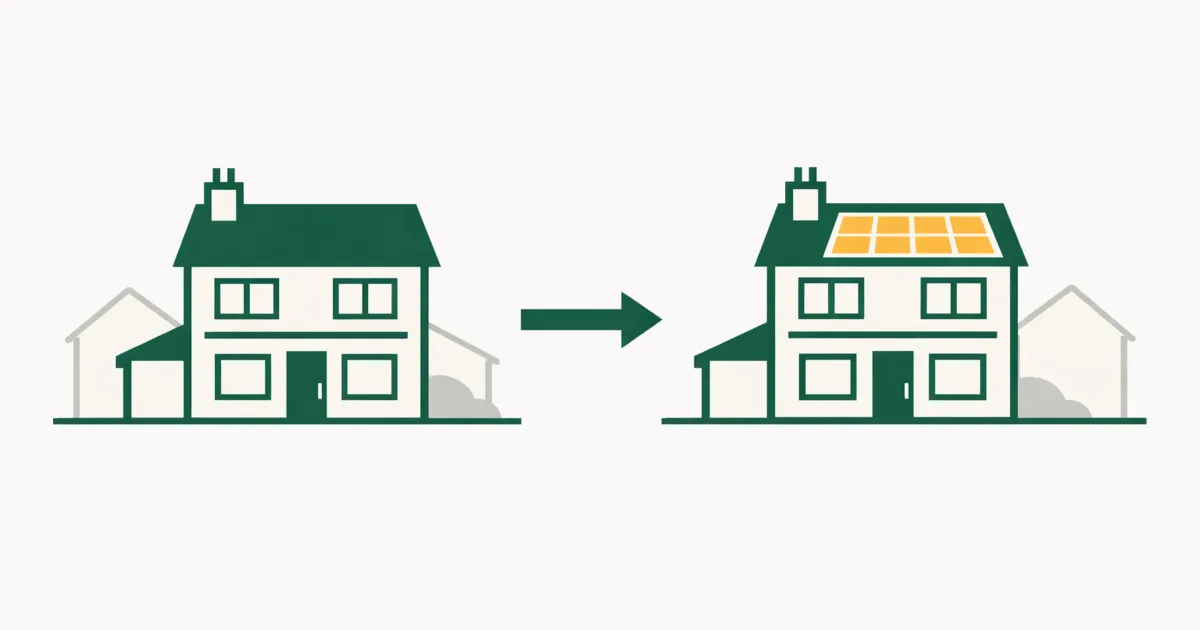
For most UK homes with a reasonably oriented, unshaded roof and a household that uses a decent share of its electricity during daylight, the answer is yes. For a meaningful minority, it is no, and the industry is not built to tell you which one you are.
The good news is that you can settle it yourself. Four inputs decide almost the whole result, all four are things you already have access to, and the arithmetic at the end fits on the back of your bill.
Input one: how much electricity you use
Find your annual consumption in kilowatt hours. It is on your annual statement and in your supplier’s app.
This sets the ceiling on what solar can save you, because the largest part of the benefit comes from not importing electricity you would otherwise have bought. On the current price cap that avoided import is worth 26.11p per kilowatt hour, per Ofgem’s July to September 2026 rates. A household using very little cannot save very much, however good the roof is: there is simply not enough import to avoid.
Input two: when you use it
This is the one people skip and it changes the answer more than anything except the roof.
Panels generate in the middle of the day. If nobody is home then and you have no storage, most of that generation is exported rather than used. Exported units are paid at the export rate, and the gap is large: Ofgem’s Smart Export Guarantee obliges suppliers only to pay something above zero, and a widely held tariff, Octopus Outgoing, pays 12p per kilowatt hour, which is less than half the capped import rate. Every unit you use yourself instead of exporting is therefore worth roughly twice as much.
If you have a smart meter, get your half hourly data and add up what you use between roughly 10am and 4pm. That share is the part solar can displace directly, and it is where the money is.
Input three: the roof
Two questions:
Which way does it face? South is best. East and west are perfectly viable, giving up around fifteen percent against south in our model, and they spread generation across the day, which sometimes suits a household better than a south facing peak at noon. North facing pitches rarely justify the spend.
What shades it? A chimney, a tree, a taller neighbour, or a dormer. Shading matters more than most people expect, because on a string inverter one shaded panel drags the string it belongs to. A quote that specifies optimisers or microinverters for a shaded roof is responding to a real problem, which is one of the reasons two honest quotes can differ by thousands.
Input four: your tariff, both directions
You need two numbers:
- Your import rate, in pence per kilowatt hour, from your bill.
- The export rate you could get, which need not be from the same supplier.
The gap between them is what makes self consumption valuable. A wide gap rewards using your own generation and makes storage more attractive. A narrow gap makes exporting less painful.
Counterintuitively, expensive electricity makes solar more worthwhile, because each unit you avoid importing saves more. Cheap overnight EV tariffs cut both ways: they lower the value of stored solar but raise the value of daytime self consumption against their higher daytime rates.
Putting it together: a worked example
The annual saving is avoided import plus export income:
- Generation, multiplied by your self consumption share, multiplied by your import rate.
- Plus the remaining generation, multiplied by your export rate.
Put real numbers through it. A 4kW system generates about 3,400 kilowatt hours a year at our model’s UK average of 850 per kilowatt on a south facing roof, and the government’s installation cost data prices it near £7,100 at the 2025/26 median of £1,780 per kilowatt.
A household that self consumes half of the generation:
- 1,700 kWh avoided import at 26.11p is about £444
- 1,700 kWh exported at 12p is about £204
- Annual saving roughly £650, so £7,100 divided by £650 is around 11 years
The same system on a house that is empty all day, self consuming a quarter:
- 850 kWh avoided import at 26.11p is about £222
- 2,550 kWh exported at 12p is about £306
- Annual saving roughly £530, and payback stretches past 13 years
Same roof, same hardware, same tariffs: the occupancy pattern alone moved the payback by more than two years. That is why no national average can answer the question for your house, and why what a 4kW system actually costs is only half the calculation.
It is also only an approximation. A serious projection handles panel degradation, an inverter replacement at some point, and the fact that a battery will not perform in year fifteen as it did in year one. Our calculator models all of that explicitly, in today’s money, with no assumed energy price inflation doing the heavy lifting. But the back of the bill version is enough to tell you whether you are in the obvious yes camp, the obvious no camp, or the middle where the detail matters.
What tips it towards yes
- Daytime occupancy, or the ability to shift loads into daylight.
- A south, east or west facing pitch with little shading.
- High electricity consumption, especially with an electric car or electric heating.
- An expensive import tariff.
- Paying outright rather than borrowing at a high rate.
- Staying in the house well beyond the payback point.
- Buying inside the current VAT window: domestic installations are zero rated until 31 March 2027, reverting to 5% afterwards.
What tips it towards no
- A predominantly north facing or heavily shaded roof.
- Very low consumption, or an empty house all day with no storage planned.
- A move planned inside the payback window.
- Finance whose interest eats most of the saving.
Neither list is exotic. Most homes sit clearly in one column or the other once the four inputs are on paper, which is the point of writing them down before anyone with a commission gets involved.
Do not accept somebody else’s assumptions
The savings figure on a quote was produced by a party with an interest in the outcome, using a self consumption assumption they probably did not state, and very often an assumed annual energy price rise compounding quietly underneath. Take your own four inputs, put them into a model that shows its working, and see whether the answer survives changing the assumption you are least sure about.
If it does, you have a decision. If it does not, you have learned which number to go and measure properly, and measuring it costs nothing but a look at your smart meter data.
Related
- Solar panel payback period: how to calculate it properlyWhy the headline figure on a quote is usually optimistic, and the arithmetic that corrects it without pretending to more precision than exists.
- Why solar panels are not worth it: five honest casesNorth roofs, empty houses, short stays, cheap tariffs and expensive finance. The situations where the sums genuinely do not work.
- Do solar panels work at night?No, and the question people are really asking is about storage. What actually covers your evening.