The ECO4 scheme and what it covers
An obligation on suppliers, aimed at specific households, closing on 31 December 2026. Who qualifies, when solar is allowed, and what to do if you do not.
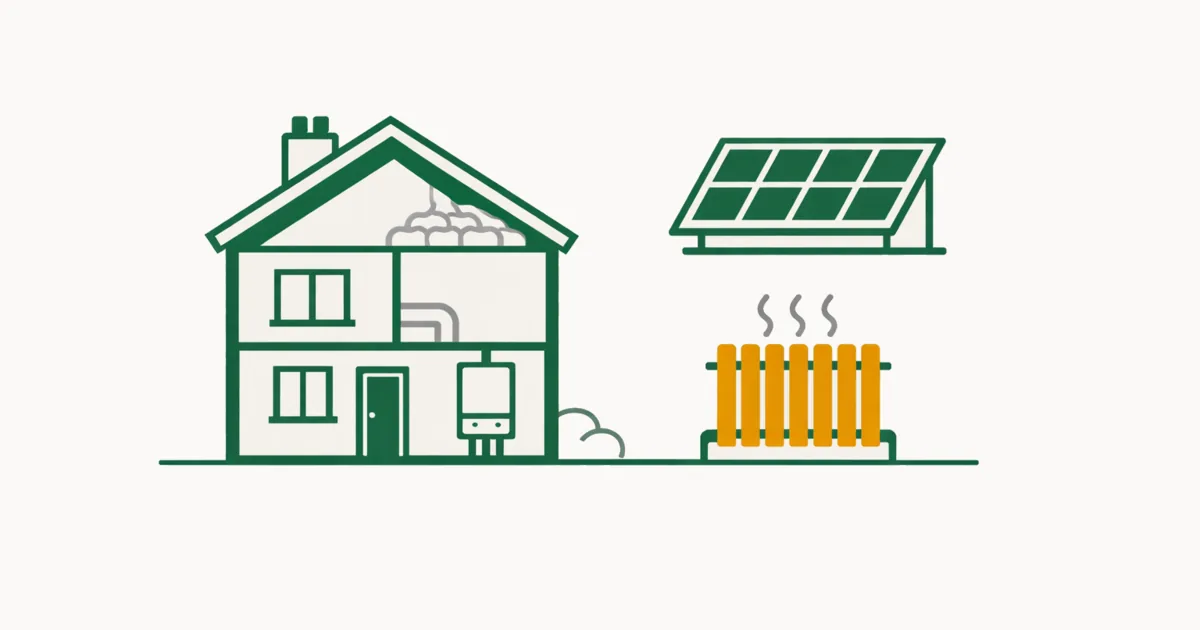
ECO is an obligation placed on larger energy suppliers to fund efficiency measures in specific households. It is a real scheme with real money, and it is also the name most often invoked by pages that have no connection to it.
Knowing what it actually funds, who for, and crucially until when, saves a great deal of time: the current scheme is in its final months, and the government has said there will not be another one like it.
What it is, and the date that now matters
ECO4, formally the Home Heating Cost Reduction Obligation, requires medium and large energy suppliers to deliver energy efficiency improvements to fuel poor and low income households. It is administered by Ofgem, whose page states the current position plainly: the scheme applies to measures installed from 1 April 2022 and runs until 31 December 2026, following a nine month extension.
The size of it is set in bill savings, not pounds spent. Ofgem’s delivery guidance puts the obligation at £224.3 million in annual bill savings, divided between suppliers by their share of the domestic gas and electricity market, and says each supplier must meet its share in full no later than 31 December 2026.
And it is the last of its kind. The government’s Warm Homes Plan, published in January 2026, says supplier obligations are being brought to a close because they “did not represent strong value for money”. The companion Great British Insulation Scheme ended as planned on 31 March 2026, and the nine month ECO4 extension was granted without any increase in delivery targets, to allow time for remediation of non-compliant work and an orderly closure.
So the pipeline is finite: assessments, surveys and installations all have to land inside the window, and suppliers get more selective as their targets fill.
The money reaches you as work done rather than as a payment. You do not apply for a grant and receive cash; you are assessed and, if eligible, measures are installed. Ofgem is explicit that ECO is not a grant scheme, and that in some cases you may be asked to contribute to the cost. The scheme operates across Great Britain; Northern Ireland has its own separate arrangements.
Who qualifies
Eligibility is narrower than the advertising implies and turns on the household and the property together. These rows were read from the official pages on 20 October 2026.
| Test | What the official page says | Source | Checked |
|---|---|---|---|
| Benefits route | Universal Credit, Pension Guarantee Credit, Pension Savings Credit, Income Support, income-based JSA, income-related ESA, Child Benefit or Housing Benefit, living in private housing | GOV.UK | 2026-10-20 |
| Flexible route (ECO4 Flex) | Combined gross household income under £31,000, or a severe or long-term health condition affected by a cold home, identified through a local authority or devolved administration | Ofgem | 2026-10-20 |
| Owner occupier | Energy rating D, E, F or G | GOV.UK | 2026-10-20 |
| Private tenant | Energy rating E, F or G, and the owner’s permission for the work | GOV.UK | 2026-10-20 |
| Social tenant | Energy rating E, F or G, for insulation or a first heating system | GOV.UK | 2026-10-20 |
Two things in that table catch people out. A home already rated C or better is outside scope whatever the household’s income, because the scheme exists to lift the least efficient homes. And the flexible route is a referral, not a self-declaration: the local authority or devolved administration has to take part and identify the household.
The official eligibility checker routes you through the questions in minutes, and is a better first step than any marketing summary.
What it funds, and the order
This is the part that disappoints people expecting panels.
Ofgem describes ECO4 as a “fabric first, multiple measure, whole house retrofit policy”. There is a minimum requirement on the outcome: a band D or E home must be lifted to at least band C, and a band F or G home to at least band D. That forces a package of measures rather than a single one fitted and left, and the package is decided by a retrofit assessment of the property, not by the household’s wish list.
Insulation comes first by rule, not by preference. Every heating measure, and solar counts as one, is subject to minimum insulation preconditions in the delivery guidance:
- Band E, F and G homes must have all exterior facing cavity walls and the loft or roof insulated, either already, as part of the same project, or with a lodged exemption where it is not possible.
- Band D homes need at least one insulation measure in the same project (roof, exterior wall, party cavity wall or floor), unless all of those are already in place.
That is not obstruction: insulating a poorly insulated home saves more per pound than an array on the same roof.
When solar is actually allowed
The guidance treats solar panels as a heating measure, and that single classification explains most of what people find confusing.
Under the current delivery guidance, solar is eligible only where the home’s heating, either before the project or installed as part of it, is a hydronic heat pump, high heat retention electric storage heaters, or an electric heating system meeting a responsiveness standard. The system must be set up so that some of the electricity generated is used by equipment that heats the home; an array exporting straight to the grid does not qualify. Solar should not be fitted where a non-electric primary heat source is planned, because it would then not reduce heating costs.
Three further rules from the same section:
- A 10 kWp cap per home, counting any existing panels: a home with 4 kWp already fitted can receive at most 6 kWp more.
- MCS certification for the installer, and installation to PAS 2035.
- A battery may be fitted during the retrofit, but scores nothing under the scheme, because it does not improve the energy rating.
So the realistic profile for panels through the ECO4 scheme is an electrically heated, poorly rated home whose household qualifies, after its loft and walls are dealt with. A gas heated home will be offered insulation and possibly a heating upgrade; panels, if they appear at all, come with a switch to electric heating, which is a much larger decision than a roof array.
A worked household that qualifies
A bungalow with electric storage heaters, rated band E, owned by a household on Universal Credit. On the rules above:
- It passes the household test on the benefits route and the property test on its rating.
- Because it is band E, the package must lift it to at least band C.
- Before any heating measure, including panels, its exterior cavity walls and loft must be insulated or exempted.
- Solar is eligible because the heating is electric storage, provided the system is wired so some of the generation feeds that heating.
The order of work is therefore: assessment, loft and cavity wall insulation, any heating upgrade, then panels.
A worked household that does not
A semi rated D, gas heated, with a household income above £31,000 and no qualifying benefit. It fails the household test on both routes. And even if it passed, panels would not be eligible while the main heating stays gas. This is the position of most households reading this article, and the next section is the useful one for them.
If you do not qualify
VAT relief on qualifying energy-saving materials applies at the zero rate until 31 March 2027, with no means test and no application: it is inside the installer’s quote. On a 4 kW system at the DESNZ 2025/26 median of £1,780 per kilowatt, about £7,121 before VAT, the zero rate saves about £1,424 against the standard 20%. From 1 April 2027 the reduced rate of 5% applies, which adds about £356 to the same job. That is larger and far more certain than most schemes people spend weeks chasing, and the VAT article covers what qualifies.
- Qualifying domestic installations are zero rated to 31 March 2027, then at the reduced rate of 5% from 1 April 2027, per HMRC Notice 708/6.
- The 20% column is the standard rate, for work that does not qualify, or a quote that has applied VAT it should not have.
- Mixed jobs can carry mixed treatment: non-qualifying work such as general roof repair done at the same time is charged at its own rate. This shows one price at one rate.
- The default price is the 4 kW system at the DESNZ 0 to 4 kW median; enter the ex-VAT figure from your own quote.
Illustrative arithmetic on the inputs shown. For a projection with degradation, replacement and your tariff, use the calculator.
Free impartial advice. The official eligibility checker linked above is free and sells nothing. Start there rather than with any company that contacts you first.
The successor money. The Warm Homes Plan sets out £5 billion for low-income schemes, with upgrade packages that can include solar, batteries, insulation and clean heat. Those schemes are run by government rather than suppliers; check the plan and your nation’s scheme for what is open, rather than any page that still sells ECO as the route.
How to approach it properly
- Check eligibility yourself on the official checker before contacting anyone.
- Contact any obligated supplier, not only your own: Ofgem says any of them can be approached. Or ask your local authority whether it takes part in the flexible route and accepts self-referral.
- Expect an assessment of the property, not an immediate installation.
- Expect fabric first. If you are offered insulation rather than panels, that is the scheme working correctly.
- Ask to see TrustMark registration. Ofgem says installers must be TrustMark registered and that you should ask for credentials if contacted.
- Move promptly. With the scheme closing at the end of 2026, a stalled enquiry is a missed one.
What the quote will say
You qualify for free solar panels under the government’s ECO4 scheme. Book your survey today.
Three questions take that sentence apart. What heating does the home have, since panels are only eligible alongside electric heating or a heat pump? Which obligated supplier is funding the work, by name? And what insulation is in the package, since a band E home cannot receive any heating measure until its loft and cavity walls are done? A caller who cannot answer all three is selling something else under the scheme’s name, and Ofgem notes you do not have to agree to, or sign for, any work you do not consider suitable.
The pages that misuse the name
A great deal of marketing invokes the scheme’s name to collect contact details, and the three checks for any grant page apply in full.
Quality is the other reason for care. The Warm Homes Plan reports that audits of external wall insulation fitted under ECO4 and the Great British Insulation Scheme found 92% had at least one major technical non-compliance, and commits to auditing every affected home. If you received that work, the remediation route runs through TrustMark at no cost to you.
Questions people ask
Can I get solar panels through ECO4 with a gas boiler?
Not while the gas boiler stays the main heating. The delivery guidance makes panels eligible only alongside a heat pump, high heat retention storage heaters or a qualifying electric heating system, fitted before or within the same project, and says a non-electric primary heat source cannot follow a solar measure. A package might swap the boiler for a heat pump and add panels, but that is a heating decision first.
Do I have to pay anything?
Sometimes. Ofgem says ECO is not a grant scheme and that in some cases you may be asked to contribute, so offers vary and are worth comparing. Private tenants need the owner’s permission for the work. If an offer asks for a contribution, compare it with the cost of buying the same panels yourself at the zero VAT rate.
What happens after 31 December 2026?
The obligation ends: suppliers must complete their share by that date, and the government has said supplier obligations will not continue. The Warm Homes Plan’s £5 billion for low-income schemes is the successor money, delivered by government schemes rather than suppliers. In Scotland and Wales the devolved schemes run on their own rules.
Check your own numbers
The scheme’s sequencing is good advice on its own. If your loft insulation is thin or your walls are uninsulated, doing that before generation will save you more per pound and make any subsequent array easier to size, because the right array size follows your consumption, and a better insulated house consumes differently. Fabric first, then generation, then the numbers: the order is the same whether anyone else is paying or not. For a household paying its own way, start from a 4 kW array on a typical home and change the usage to yours: open the calculator with the worked example loaded.
The full set of schemes and funding routes is collected in solar panel grants and funding in the UK. If you are still looking for businesses to quote, our installer directory lists Google’s listings near a postcode: Google data, so check MCS status yourself on the register.
Sources
- Ofgem, Energy Company Obligation (ECO): ECO4 from 1 April 2022 to 31 December 2026 after a nine month extension. Checked 2026-10-20, ofgem.gov.uk.
- Ofgem, ECO4 Delivery Guidance, version 4.0 published 26 March 2026: the £224.3 million obligation, the band C and D minimum requirement, the insulation preconditions, and the solar PV rules (heating types, generation used for heat, 10 kWp cap, MCS and PAS 2035, batteries). Checked 2026-10-20, ofgem.gov.uk.
- Ofgem, ECO for homeowners and tenants: ECO4 Flex income under £31,000, contributions, contacting any obligated supplier, TrustMark. Checked 2026-10-20, ofgem.gov.uk.
- GOV.UK, Energy Company Obligation: qualifying benefits and energy rating by tenure. Checked 2026-10-20, gov.uk.
- Department for Energy Security and Net Zero, Warm Homes Plan, published 21 January 2026 and updated 18 March 2026: the end of supplier obligations, the Great British Insulation Scheme closing on 31 March 2026, £5 billion for low-income schemes, the 92% external wall insulation non-compliance finding. Checked 2026-10-20, gov.uk.
- HMRC, VAT on energy-saving materials and heating equipment, Notice 708/6: zero rate to 31 March 2027, 5% from 1 April 2027. Checked 2026-10-20, gov.uk.
- Department for Energy Security and Net Zero, Solar PV cost data, 2025/26 edition published 28 May 2026, median of £1,780 per kilowatt for systems up to 4 kW. Checked 2026-10-19, gov.uk.
- The two households are illustrations of the published rules, labelled as such.
Related
- Solar panel grants in the UK: what actually exists in 2026Every live UK scheme that can fund solar panels, checked against its own page on 2026-10-19, and the three tests that expose a lead generation page.
- Solar panel finance: what the monthly figure hidesCompare total repayable against the cash price, not the monthly payment against your bill: the arithmetic, the clauses, and how to get the interest removed.
- VAT on solar panels and batteriesZero rated inside the quote, not reclaimed by you. The dates, what the relief covers, what it does not, and what it is worth on a typical system.