Export MPAN: what it is, how to get one, and why export payments wait for it
The meter point reference for electricity you send to the grid: who creates it, who applies, how long the network operator takes, and what waits on it.
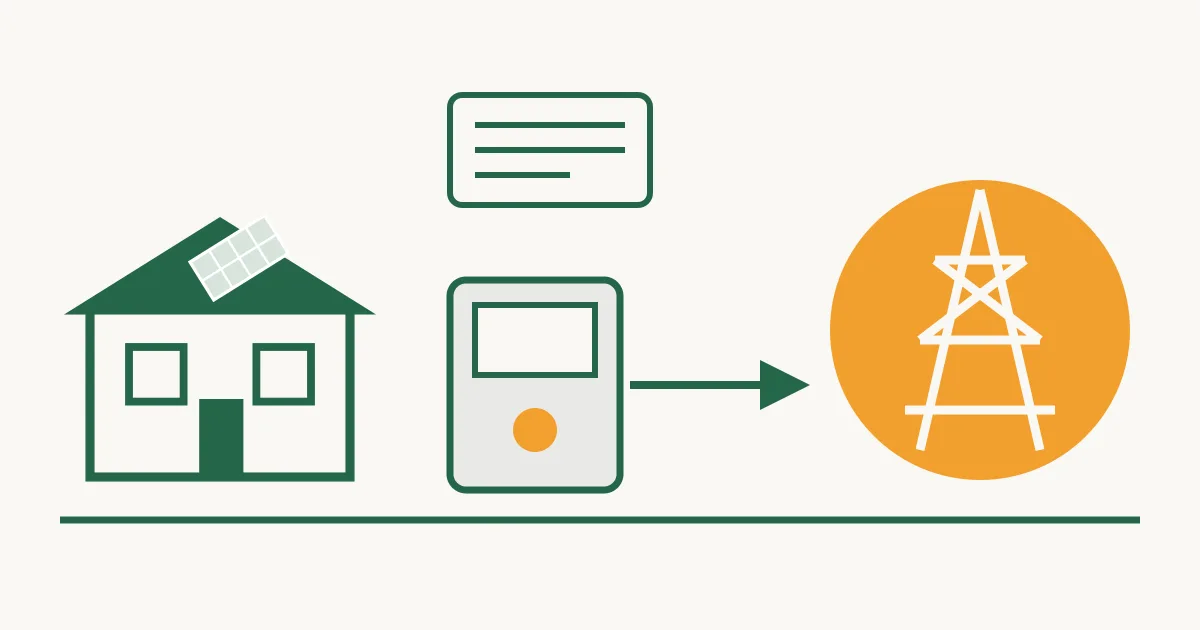
An export MPAN is the reference number the electricity industry uses for the power your panels send out to the grid. Without one, no supplier has anywhere to record your exports, and so no supplier can pay you for them. It is the least glamorous step in getting solar working, and the one most likely to leave a new system exporting for nothing for weeks.
This page covers what it is, how you get one, who does the work, how long the one slow step takes, and what to ask so that your first export is paid for. Everything is in today’s money, with no assumed rise in rates.
What an export MPAN is
MPAN stands for meter point administration number. Your house already has one for the electricity you draw from the grid, the import MPAN. An export MPAN is a second reference, for electricity flowing the other way. A supplier’s explainer, checked 25 October 2026, describes it as a 21-digit reference, and says solar owners need both: the import number covers what you draw, the export number covers what you send out.
The reason it matters is on the Smart Export Guarantee side. Under that scheme, as gov.uk sets out, you need a renewable generating system that meets the requirements, an installation and installer certified under the Microgeneration Certification Scheme or an equivalent, and a meter capable of providing half-hourly export readings. You must also apply directly to a SEG supplier to get paid, and that supplier does not have to be the one that supplies your electricity. The gov.uk page does not mention the MPAN by name. The MPAN is how the industry’s systems keep track of those exports.
The Smart Export Guarantee explainer covers the scheme itself; this page is about the one reference number it depends on.
Why export payments cannot start without it
Two suppliers say it in their own words. Octopus Energy’s export page says that a new MPAN must be requested from the distribution network operator, that Octopus applies to the operator on your behalf, and that written approval from the operator for the new MPAN is needed. Utilita’s scheme page says that for a first-time export a new MPAN must be requested from the operator, and that if you already have an export MPAN it can move straight to the next step.
So the order is fixed: the operator creates the number, then the supplier can set up the payments against it. Until that has happened your panels may be generating and your house may be exporting, but nothing is being credited.
What it costs you to wait
Each month without an export reference is a month of export paid at nothing. A rough scale, using the two rates on the export rate comparison: on 2,000 kilowatt hours of export a year, Octopus’s open rate of 4.1p is about £82 a year and its Outgoing rate of 12p about £240. A month of lost export is a twelfth of that, about £6.83 or £20.00. Those figures are illustrations at one household’s volume, not a forecast, and your own export will be higher in summer and near nothing in winter. The point is that delay is cheap in absolute terms but not free.
- Conditional package: export on Octopus Outgoing export rate at 12p, import at 26.32p, the Ofgem price cap unit rate (Ofgem cap, 1 October to 31 December 2026), standing for the supplier's standard rate.
- Split package: export on the Octopus open SEG rate at 4.1p, import on an independent deal at the rate you set; the article's illustration is 24.32p, not a real tariff.
- Unit rates only: standing charges, which differ between tariffs, are not included. Year one, nothing inflated.
Illustrative arithmetic on the inputs shown. For a projection with degradation, replacement and your tariff, use the calculator.
How you get one
The route is the same whichever supplier you pay, with different people doing different steps.
| Step | Who usually does it | What it needs | Checked |
|---|---|---|---|
| 1. Certify the installation | Your installer | An MCS certificate or an equivalent scheme | 2026-10-25 |
| 2. Notify or apply to the network operator | Your installer, then often the supplier | A G98 form for most domestic systems, G99 for larger ones | 2026-10-25 |
| 3. Create the export reference | The network operator | The application and its approval | 2026-10-25 |
| 4. Get a meter that reads export | Your supplier | A working smart meter, typically | 2026-10-25 |
| 5. Apply to a SEG supplier | You | Proof of identity and ownership, per Utilita’s page | 2026-10-25 |
1. The MCS certificate
You need your installation and installer certified. Both gov.uk and Octopus say this, naming the Microgeneration Certification Scheme or an equivalent, and Octopus names FlexiOrb. Your installer should provide the certificate. If your system is not certified, no export reference will fix it: the installer who certified it has to put that right first.
2. The network operator
The operator is not your supplier. It is the company that owns the cables in your area, and you can find yours with a postcode lookup on the Energy Networks Association site. The supplier explainer says most domestic systems apply with a G98 form and larger ones with a G99, that your installer may already have done it, and that once approved the operator issues the export MPAN. The operator application post explains which of the two applies to you and what a refusal looks like.
3. The smart meter
Octopus says you need a working smart meter and a meter capable of half hourly export readings, and that if you do not have a smart meter it can arrange one. The supplier explainer adds that most second generation meters are export-ready, while some first generation ones may need an update or replacement, which your supplier can confirm. Your supplier can confirm which yours is.
4. The supplier
Octopus and Utilita both apply to the operator on your behalf. That is their service, not a universal rule, so ask your own supplier whether it does the application or whether you must.
How long it takes
The one figure a supplier states is Utilita’s: creating the export reference is listed as 1 to 4 weeks, and the page notes the step can take a little longer as it is managed by the network operator. Octopus’s page gives no duration. The supplier explainer says how long the application takes is not stated.
So plan on weeks, not days, and start the application as soon as the installation is certified rather than after the first bill. If your system is over the G98 limit and needs a G99 permission before you can connect, the operator application post shows why that can add time before the MPAN step even begins.
What to ask so the first export is paid
- Who applies to the operator for the MPAN, me, my installer or the supplier? Get the answer in writing.
- Has the application been made, and what is the reference? Ask for confirmation of the date.
- Will export before the MPAN exists be paid? The pages checked say nothing about back payment, so it is not stated. Ask before you assume it.
- Is my meter export-ready? Check before the installation day, not after.
- If I already export, can I keep my existing MPAN? Utilita says an existing export reference lets it move straight on, so switching supplier on an existing system should be quicker than a first connection.
If you already have solar and no export reference
A system installed some time ago, or under the old Feed-in Tariff, may have different arrangements. gov.uk says you cannot receive a SEG tariff while you are receiving export payments under the Feed-in Tariff scheme. If you are unsure whether you have an export reference, your supplier can tell you what is on record for your address.
Questions people ask
What is an export reference?
The reference number for the electricity your panels send to the grid. Your import MPAN covers what you draw; the export reference covers what you send out. Without it your supplier cannot formally record your exports.
How do I get an export reference?
The network operator creates it. Your installer certifies the system and notifies or applies to the operator, and many suppliers, including Octopus and Utilita, apply to the operator for you once you ask for an export tariff.
How long does an export reference take?
Utilita lists 1 to 4 weeks for the step and says it can take longer. Octopus gives no figure. Treat it as weeks, and start early.
Do I need an MCS certificate to get an export reference?
You need one to be paid under the Smart Export Guarantee. The explainer describes MCS or an equivalent as part of qualifying for an export reference as well, so ask your installer for the certificate.
Can I get paid for export without a smart meter?
You need a meter capable of half-hourly export readings, which is typically a smart meter, per gov.uk. If you do not have one, speak to your supplier.
Check your own numbers
Take your expected export, from the installer’s estimate or last summer’s meter data, and multiply by the export rate you will be paid. That is what each month of delay costs. The calculator models export at the Smart Export Guarantee rate in today’s money, so you can see how much of the system’s return depends on it. Start from a 4 kW array with no battery: open the calculator with the worked example loaded.
The rest of the tariff questions are gathered in solar tariffs and export payments explained.
Sources
- GOV.UK, Smart Export Guarantee: MCS or equivalent, a meter capable of half-hourly export readings, apply directly to a SEG supplier, no SEG with Feed-in Tariff payments; MPAN not mentioned. Checked 2026-10-25, gov.uk.
- Octopus Energy, Smart Export Guarantee: a new MPAN must be requested from the network operator, Octopus applies on your behalf, written approval needed; MCS or FlexiOrb; working smart meter; start date for payments not stated. Checked 2026-10-25, octopus.energy.
- Utilita, Smart Export Guarantee: Utilita applies to the operator; creating the export reference is listed as 1 to 4 weeks; proof of identity and ownership. Checked 2026-10-25, utilita.co.uk.
- Fuse Energy, Export reference: a 21-digit reference, G98 or G99 application, smart meter, no duration or fee stated. Checked 2026-10-25, fuseenergy.com.
- Octopus Energy, Smart Export Guarantee: Outgoing at 12p and the open rate at 4.1p, used for the scale of a month’s export. Checked 2026-10-19, octopus.energy.
- The 2,000 kilowatt hours of annual export and the monthly figures derived from it are illustrations, labelled as such. How long operator approval takes beyond Utilita’s stated range, and whether export before the MPAN is paid, are not stated on any page checked.
Related
- Smart Export Guarantee explained: what you actually get paidHow the SEG works, who has to offer it, what you need in place to qualify, and why the rates on offer differ so enormously.
- The network operator application, explainedG98 notification against G99 permission, which applies to you, and what a refusal looks like.
- Smart Export Guarantee rates comparedWhat suppliers pay, the conditions attached to the headline numbers, and how to work out which offer is actually best for your household.