Chargers that follow your solar surplus
The feature that makes charging from your own roof actually work, its trade-off, and the tariff pair that decides whether to switch it on at all.
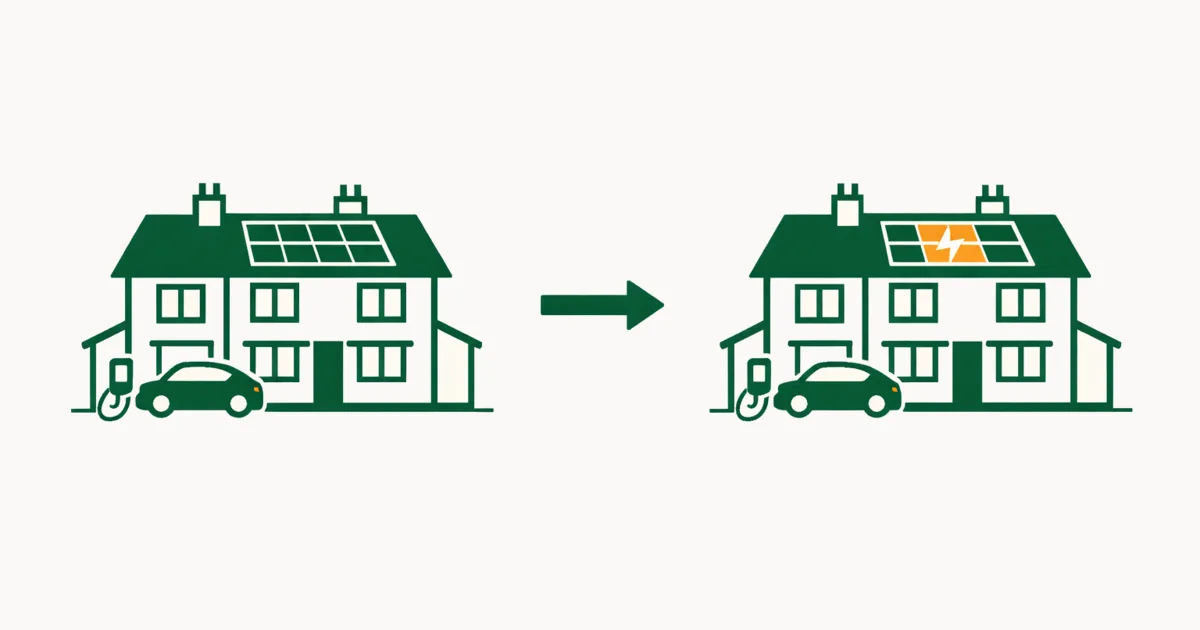
A home charger draws around seven kilowatts. A typical domestic solar array is smaller than that, and only reaches its peak in good conditions around midday. Plug a car in at full rate and most of what it takes is imported, whatever the roof was doing earlier.
Solar matching is the feature that fixes this, and it is the difference between charging from your own generation and merely charging while generating. Whether it is worth using, though, depends on your tariff pair, and that check belongs before the purchase.
What it does
A charger with solar matching, the myenergi zappi made the category famous, monitors the flow at your meter. When your array is producing more than the house is consuming, it feeds that surplus to the car and no more.
Generation rises, the charge rate rises. A cloud passes, the rate falls. The car takes what is spare, and nothing is imported.
Most implementations offer three modes, and the zappi’s datasheet describes its three in terms that apply to the category:
Solar only. Charges purely from surplus. Stops entirely when there is none; the zappi calls it ECO+, where charging “will pause if there is too much imported power, continuing only when there is surplus free power available”.
Solar plus a top-up. Uses surplus preferentially but draws a set minimum from the grid so the car makes progress regardless. Usually the useful setting; ECO on the zappi, where charging “will continue until the vehicle is fully charged, even if power is drawn from the grid”.
Full rate. Ignores generation and charges as fast as the supply allows. FAST on the zappi, “just like an ordinary Mode 3 charging point”.
Why it is worth money, and when it is not
The value of a generated unit depends on what happens to it. Used in the house it saves the October to December 2026 cap of 26.32p. Exported it earns your export rate, 12p on Octopus Outgoing.
On a flat tariff, every unit a solar-matched charger puts into the car is converted from 12p to 26.32p of value, a gain of about 14.3p, so 1,000 diverted kilowatt hours a year is worth about £143. It is the same logic as a battery, applied to a battery you already own and park on the drive, and it captures the gap at no marginal cost per unit. The widget shows the split and what shifting units from export into use is worth at either export rate.
- Import at 26.32p, the Ofgem price cap unit rate (Ofgem cap, 1 October to 31 December 2026); export at the rate selected, from the Octopus SEG page (checked 2026-10-19).
- The gap between the two rates is 14.32p: what every kilowatt hour moved from export to use is worth. A 2p better export rate is the article's comparison, applied to the units still exported.
- Generation and the share used are yours to set; the shift is capped at what is exported. Year one, nothing inflated.
Illustrative arithmetic on the inputs shown. For a projection with degradation, replacement and your tariff, use the calculator.
On a cheap overnight EV tariff the arithmetic flips. With Intelligent Octopus Go at 8p off peak, a surplus unit driven into the car saves you an 8p overnight import while costing you 12p of export income: a loss of about 4p per unit, worked through in the charging-from-solar guide. That assumes Outgoing is available alongside the EV tariff, which Octopus does not confirm: its export page, checked on 20 October 2026, says EV tariff customers can pair with certain export tariffs without listing which, and describes the 12p rate for customers on a standard import tariff. On the open 4.1p rate, the pairing anyone can have, diverting gains about 3.9p a unit instead. The feature still functions perfectly; the tariff has simply made exporting and charging overnight the better trade. Run your own pair before configuring it, and rerun it when you switch tariff.
The pattern, in order, with the pounds
- Write down the tariff pair. Import rate at the hours the car would otherwise charge, and export rate. Flat 26.32p against 12p: a 14.3p gain per diverted unit. Overnight 8p against 12p: a 4p loss. The sign of that number decides everything that follows.
- Count the hours the car is on the drive in daylight. A weekend car sees two days in seven of the surplus; a home-worker’s car sees most of it. A 4 kW array exporting about 2,040 kWh a year offers roughly 580 kWh to the weekend car and most of the 2,040 to the other.
- Multiply. Weekend car on a flat tariff: 580 kWh at 14.3p, about £83 a year. Home car on a flat tariff: 1,500 kWh at 14.3p, about £215. Either car on the overnight tariff: a loss, so stop here and use FAST.
- Price the feature. The zappi GLO is sold installed by E.ON Next at £1,250 untethered; a retailer listed the tethered unit alone at £511. Against a plain charger the solar-matching premium is the gap between the two quotes you get, and £83 a year recovers a £200 premium in about 2.4 years and a £500 one in about 6.
- Fit the sensor with the charger. The clip-on grid sensor is what the matching reads; it is cheap on the day and a second visit later.
A worked household: the weekend car on a flat tariff
A 4 kW south facing array making 3,400 kWh at the site model’s 850 per kilowatt, 40% used at home, about 2,040 kWh exported in daylight. The car is away on weekdays and on the drive at weekends, so the charger diverts about 580 kWh a year, an assumption.
- Each diverted unit: 26.32p of import avoided, 12p of export forgone, about 14.3p gained
- Year: about £83
Against the car’s whole year, 8,000 miles at the 3.5 miles per kWh the other charging posts use, plus an illustrative tenth lost in charging, is about 2,510 kWh from the wall, so the roof is feeding under a quarter of it and the rest is the tariff’s business.
A second household: the home-worker’s car on an overnight tariff
The same array, the car on the drive most days, the household on Intelligent Octopus Go because of it. The charger could divert 1,500 kWh.
- Each diverted unit, if Octopus allows Outgoing alongside the EV tariff: 8p of overnight import avoided, 12p of export forgone, about 4p lost
- Year: about £60 worse off than exporting and charging at night
So this household sets FAST, charges in the 23:30 to 05:30 window, and lets the roof export. On the open 4.1p Smart Export Guarantee rate, the pairing Octopus confirms for anyone, the sign flips back: 8p avoided against 4.1p forgone, a 3.9p gain, about £59 on 1,500 kWh. The export rate is doing the deciding, not the charger.
What the quote will say
Solar EV charger: charge your car for free from your own panels.
Free in the sense that the units were going to be sold at the export rate, so each costs the export rate forgone: 12p on Outgoing, 4.1p on the open rate. Against an overnight tariff at 8p the sunshine is dearer than the grid. Ask what import and export rates the saving assumes, how many daylight hours a week the car is on the drive, and whether the quote has allowed for the 1.4 kW floor below which nothing is diverted.
The catch: it is slow
Charging from surplus alone is slow and intermittent. A domestic array in British conditions rarely offers a steady surplus of more than a few kilowatts, and often much less: even a bright day’s 3 kilowatt surplus is under half the charger’s full rate.
That suits a car sitting on a drive all day, adding usable range across the daylight hours. It does not suit one that needs to be substantially charged in two hours.
In practice most households use solar matching opportunistically, at weekends and on home-working days, and fall back to a cheap overnight rate at around 2p a mile the rest of the time. That blend is the right answer for most people rather than a failure of the feature.
The minimum current problem
Worth knowing before you buy. Charging standards impose a minimum current below which a car will not charge at all, six amps, which is roughly 1.4 kilowatts on a single-phase supply; the zappi’s datasheet gives its range as “6A to 32A (Variable)” and its product page says that “if the surplus generation drops below 1.4kWh, some power will be drawn from the grid to top it back up”.
So a surplus of five hundred watts cannot be used by the car. It has to reach the minimum threshold before charging can start, which on a dull day may not happen at all, and on a mixed day means sessions stopping and starting as clouds pass.
The top-up mode exists partly to solve this: it makes up the difference from the grid so the session can begin, and only the make-up units are imported. Some chargers manage this more gracefully than others, and it is worth asking how a specific unit behaves at low surplus, because the graceless ones abandon sessions a passing cloud interrupted.
What you need
- A charger that supports it, with the mode you want included rather than sold as an upgrade, one of the two features that actually matter in a charger.
- A meter clamp or equivalent on your incoming supply, so the charger can see the flow in each direction. Installed at the same time, and cheap then.
- A car that tolerates variable rates. Most do. A few handle frequent rate changes poorly and will stop the session. Check yours before paying for the feature it would defeat.
Against a battery
Both raise self-consumption. They are not alternatives so much as complementary, and the order matters.
If the car is home during the day, solar matching is far cheaper than storage and captures much of the same surplus: the charger feature costs tens or a few hundred pounds against a battery’s thousands, for the same 14.3p per unit on a flat tariff. Do that first.
If the car is away all day and returns in the evening, solar matching has nothing to work with, and a battery is what bridges the gap by holding midday generation until the car arrives, at its own per-cycled-unit economics.
Questions people ask
Can I charge my electric car from solar panels?
Yes, with a charger that tracks the surplus at the meter and feeds it to the car between 6 A and 32 A. How much depends on when the car is home: a weekend car on a 4 kW array might take about 580 kWh a year of surplus and a car home most days most of the 2,040 kWh exported. The car’s whole year is about 2,510 kWh at 8,000 miles, so the roof is a share, not the supply.
Is solar charging worth it on an EV tariff?
It depends on the export tariff the EV tariff allows. At 8p overnight against 12p export, if Octopus lets you pair them, each diverted unit loses about 4p. On the open 4.1p export rate, the pairing anyone can have, diverting gains about 3.9p a unit. The export rate decides it, and which EV tariff suits your mileage is the sum to do first.
Why does the charger keep stopping on cloudy days?
Because a car will not charge below about 6 A, about 1.4 kW, and a surplus that dips under that cannot start a session. Solar-only mode waits; top-up mode draws the shortfall from the grid so the session continues. On a mixed day the top-up mode is the one that keeps the car moving.
Does solar matching replace a home battery?
For a car home in the day it captures much of the same surplus at a fraction of the price, so it comes first. For a car away all day it captures nothing, and a battery holding the midday surplus for the evening is the only route; the two together are a sizing question for the evening that remains.
Check your own numbers
Work out which household describes you before spending on either, and if the answer is “both, eventually”, size the battery on the evening that remains after the car has eaten the daytime surplus. The calculator takes the panels, the car’s usage and your occupancy together and runs the projection in today’s money. Start from the home-worker’s household with the EV switched on, then change the occupancy to the weekend pattern: open the calculator with the worked example loaded.
The tariff and running cost questions are gathered in EV charging at home: costs and solar.
Sources
- myenergi, zappi v2.1 datasheet, revision 2.1.4, June 2022: the three modes and their descriptions, “6A to 32A (Variable)”, the clip-on grid sensors. Checked 2026-10-20, myenergi.com.
- myenergi, zappi EV charger page: the 1.4 kW surplus threshold. Checked 2026-10-20, myenergi.com.
- E.ON Next, Home EV chargers: zappi GLO £1,250 installed. Checked 2026-10-20, eonnext.com.
- Eco Wizard, myenergi zappi GLO 7 kW tethered: £511 including VAT for the unit. Checked 2026-10-20, ecowizard.co.uk.
- Octopus Energy, Intelligent Octopus Go: 8p per kWh between 23:30 and 05:30, as advertised. Checked 2026-10-20, octopus.energy.
- Octopus Energy, Smart Export Guarantee: Outgoing at 12p and the open SEG rate at 4.1p. Checked 2026-10-19, octopus.energy.
- Ofgem, Changes to the energy price cap between 1 October and 31 December 2026: 26.32p per kWh. Checked 2026-10-20, ofgem.gov.uk.
- gowith.solar, What the calculator models, for the 850 kWh per kilowatt figure, what the calculator models.
- The 580 and 1,500 kWh diverted, the 40% share, the £200 and £500 premiums and the quote box are illustrations, labelled as such.
Related
- Charging your EV from solar: how much you can actually useWhy a 7kW charger and a 4kW array rarely meet, and the three things that close the gap between generation and when the car is plugged in.
- Choosing a home EV chargerScheduling and solar-matching are the two features that change what you pay. The rest is styling.
- What charging an EV at home actually costsPence per mile on each common tariff, against public rapid charging, worked from figures you can read off your own car and bill.