Skip to content
gowith.solar

Follow the sun across your roof

Scrub through the day, turn the roof and watch an obstacle's shadow move. See the geometry behind a sunny summer roof and a shaded winter one.

My home Saved defaults for your calculator and tools

Loading your home settings…

Free accounts remember your home across devices. Sign in

Home size
Home postcode
Address (optional)
Known annual electricity use (kWh)

No annual usage saved yet.

Weekdays at home
Electric vehicle
Roof faces

Keep each roof face separate, for example east and west. Tools use the selected face.

Home fields autosave when you edit them. Opening a shared scenario never changes your saved home. Existing quote reports keep their original settings.

Your situation

Choose a dayExample figures
When
Your roof

Measured clockwise from north: east 90°, south 180°, west 270°.

Something that casts a shadow

Set 0 to remove the obstacle.

More assumptionslatitude, longitude
Calculating your scenario…

A separate generation reference

The sun scene explains geometry. PVGIS estimates monthly AC generation from historical weather and an independent model. The illustrated obstruction does not change this chart.

Illustrative starting capacity. Use your proposed system.

An editable modelling assumption, separate from local shading.

Select for panels integrated into the roof; otherwise use the ventilated mounting model.

Uses the location, roof direction and pitch above. Profiles load only when you request one. Requests and reads use no paid-document allowance.

Understand your result

A closer look at the calculation

The context behind the numbers, so you can decide what to check next.

Follow the sun across the day

The sun's position changes with time, date and location. Changing those inputs moves the illustrated sun and makes it easier to see why the same obstruction casts different shadows through the day.

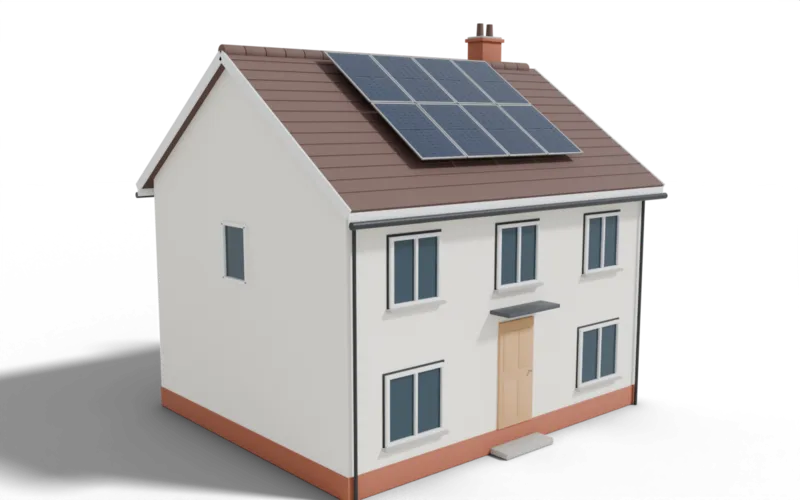
Roof direction and the position and height of an obstruction affect where the shadow falls. The house and obstacle are editable examples, not measurements of your property.

Read shadows as geometry

A low sun can cast a long shadow; a higher sun can produce a shorter one. The displayed shape is a simplified geometric illustration and does not account for every nearby object or changing vegetation.

A shadow touching a panel is not equivalent to a fixed percentage of annual energy loss. Timing, module wiring, inverter equipment and diffuse light all matter.

Use a site-specific shade assessment

The scene is useful for asking an installer better questions about chimneys, trees and nearby buildings. It cannot establish measured shading or predict annual solar generation.

For an installation decision, obtain a site assessment and compare generation estimates with their location, orientation, weather and shading assumptions stated.

Take it further

Solar and battery ROI calculator

You know what fits. Now see whether it pays back.

The ROI calculator takes a roof direction and system size and models generation, self-consumption, export income and replacements, all in today's prices.

Open the ROI calculator

Before you rely on this

Scrub through the day, turn the roof and watch an obstacle's shadow move. See the geometry behind a sunny summer roof and a shaded winter one.

  • The house and obstruction are examples you can edit, not a survey of your property.
  • Shadows illustrate geometry. They do not measure annual generation lost to shade.

Reference sources

Calculated results show their method version, assumptions and any data sources under "How this was calculated". Example starting figures are illustrations, not measurements.

Common questions

Why does my roof get so much less sun in winter than in summer?

In winter the sun stays low in the sky and its path across the day is short, so light meets a pitched roof at a shallower angle and for fewer hours. The tool plots the sun's position through the day for a date you choose, so you can compare midsummer, the autumn equinox and midwinter on the same roof. It shows the geometry rather than measuring how much electricity you would lose.

How long will the shadow from my chimney or tree be?

Pick a chimney or a tree, give its height and its distance from the roof centre, and move the time slider to watch the shadow change. The shadow length is worked out from the obstacle's height and the sun's height at that moment, assuming a vertical object on level ground. It is an illustration with an example house, not a survey of your property.

Does the direction my roof faces change how much sun it catches?

Yes. You can turn the roof between east, south-east, south, south-west and west and set its pitch, and the tool shows how directly the sun is hitting the roof at the chosen time. It reports this as an angle-of-incidence figure, which is a measure of geometry and not of annual generation or panel efficiency.

What times and locations does the sun path tool use?

Times are UK clock time, so the clocks changing in spring and autumn are handled for you. By default it uses a location in London, and in the advanced settings you can enter a latitude and longitude anywhere in the UK range the form allows. The sun's position comes from published solar-position equations that ignore the bending of light by the atmosphere.

Can this tool tell me how much shade will cost me in solar generation?

No. It shows where shadows fall and when, which helps you spot a problem, but it does not turn that into lost kilowatt hours. For an annual generation estimate you would need a separate tool or an installer's shading survey.