Skip to content
gowith.solar

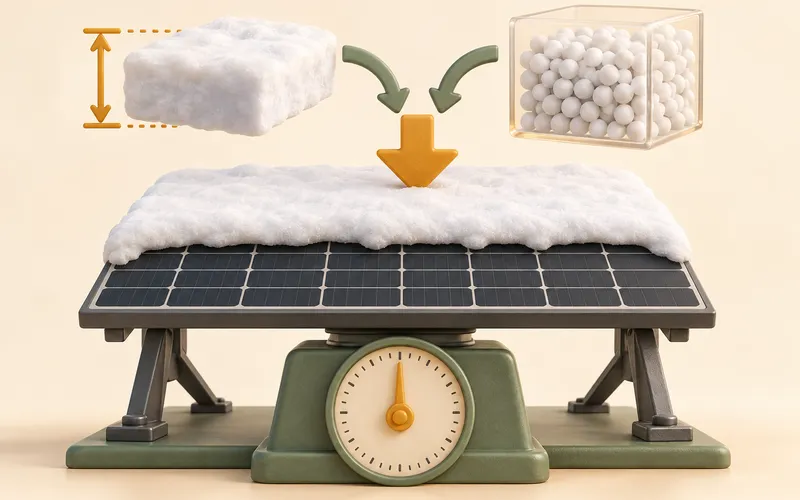
Solar panel snow weight calculator: uniform layer illustration

Illustrate the weight of a uniform snow layer using entered depth, density and area.

Your situation

Assumed uniform layer

Use the horizontal projected area, not the sloping panel surface.

An example layer depth, not a prediction of accumulation.

Density varies greatly; replace this example with an appropriate measured value.

Calculated from your figures

400 kg assumed snow mass

Layer volume
2 m³
Vertical weight
3.92 kN
Weight per horizontal area
0.392 kPa

What this means

Weight of an entered uniform layer over a horizontal footprint, not a structural safety or design assessment.

The working

The maths, step by step

volume (m3)=10×20÷100=2\text{volume}\,(\mathrm{m}^{3}) = 10 \times 20 \div 100 = 2
mass (kg)=2×200=400\text{mass (kg)} = 2 \times 200 = 400
weight (kN)=400×9.80665÷1000=3.92266\text{weight (kN)} = 400 \times 9.80665 \div 1000 = 3.92266
weight per horizontal area (kPa)=(20÷100)×200×9.80665÷1000=0.392266\text{weight per horizontal area (kPa)} = (20 \div 100) \times 200 \times 9.80665 \div 1000 = 0.392266

This describes an assumed uniform layer only. It is not a design snow load or a roof safety assessment.

Understand your result

A closer look at the calculation

The context behind the numbers, so you can decide what to check next.

Weight of an assumed layer

The calculator treats snow as a uniform layer above a horizontal footprint. Multiplying horizontal area by vertical depth gives a volume; multiplying that volume by entered density gives mass. Standard gravity converts mass to weight.

The result is illustrative arithmetic for the values entered. It does not predict how much snow will settle on solar panels or a roof.

Snow density and depth change

Fresh, wet, compacted and melting snow can have different densities. Depth and density can also vary across the same roof. The starting numbers are examples, not local observations or design values.

The footprint is projected horizontally and depth is vertical. Do not substitute the sloping surface area and then treat the result as the weight of the same vertical layer.

Why this is not a roof load design

Real accumulation is affected by drifting, sliding, roof geometry, obstructions and exposure. Forces on panels, fixings and the building are not necessarily uniform. Design also needs local conditions, appropriate load combinations and applicable standards.

A structural engineer should assess the roof and mounting system. Do not use this illustration to decide whether a roof is safe, whether panels can be installed, or whether snow should be removed.

Take it further

Solar and battery ROI calculator

You know what fits. Now see whether it pays back.

The ROI calculator takes a roof direction and system size and models generation, self-consumption, export income and replacements, all in today's prices.

Open the ROI calculator

Before you rely on this

Illustrate the weight of a uniform snow layer using entered depth, density and area.

  • The layer is uniform, with a vertical depth above the entered horizontal footprint; depth and density are user assumptions.
  • This is not a design snow load or an assessment of panel, fixing or roof safety; drifting, sliding and load combinations are excluded.

Reference sources

Calculated results show their method version, assumptions and any data sources under "How this was calculated". Example starting figures are illustrations, not measurements.

Common questions

Does this tell me if my roof is safe?

No. It calculates the weight of an assumed uniform layer, not structural capacity or a design snow load.

Which area should I enter?

Enter the horizontal projected footprint covered by the assumed layer, and use vertical snow depth.

Is the example snow density typical?

It is only an illustration. Snow density varies with conditions and should be measured or otherwise established for the scenario.

Does this account for drifting and sliding?

No. Real accumulation can be uneven and requires a site-specific structural assessment.