Skip to content
gowith.solar

How much of your solar electricity do you use directly?

See direct solar use as a share of generation and as a share of household electricity demand.

Your situation

Your same-period electricity

Use quantities from the same period. This scenario has no battery, curtailment or unmetered losses.

Use solar consumed immediately, not energy discharged from a battery.

Include electricity supplied directly by solar as well as grid imports.

Share of solar generation used directly50%
Share of household demand met directly40%

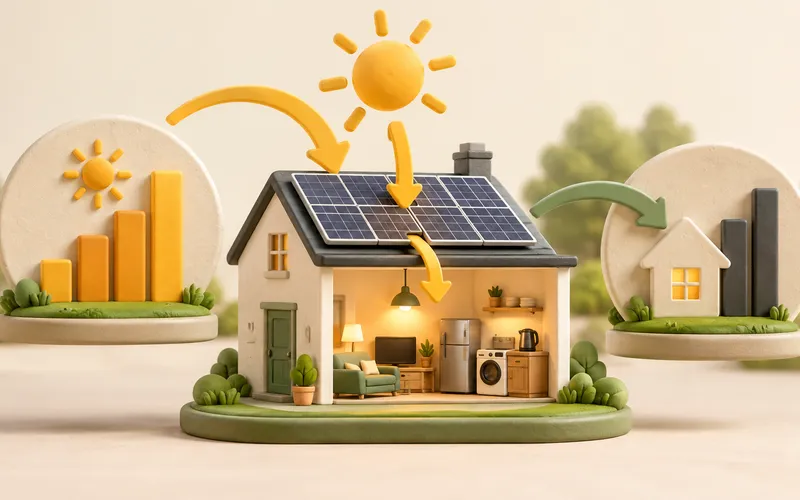
The bars have different denominators. This scenario excludes battery flows.

Calculated from your figures

50% of generation used directly

Share of household demand
40%
Assumed export
2,000 kWh

What this means

The self-sufficiency share uses household demand as its denominator. This scenario assumes no battery or curtailment.

How this was calculated

Based on the figures you entered.

  • Enter same-period generation, direct solar use and total household demand.
  • The remainder is treated as export, without battery flows, curtailment or unmetered losses.

Method direct-solar-use-v1

The working

The maths, step by step

The figures match the displayed result and are rounded for display.

self-consumption (%)=solar used directlysolar generated×100\text{self-consumption (\%)} = \frac{\text{solar used directly}}{\text{solar generated}} \times 100
2000÷4000×100≈50%2000 \div 4000 \times 100 \approx 50\%

Self-sufficiency uses household demand as the denominator: 2000 ÷ 5000 × 100 = 40% after rounding.

Understand your result

A closer look at the calculation

The context behind the numbers, so you can decide what to check next.

Two different percentages

Self-consumption is direct solar use divided by solar generation. Self-sufficiency is direct solar use divided by total household electricity demand. They answer different questions and use different denominators.

Use quantities measured or estimated for the same dates. Household demand includes electricity used directly from the panels as well as electricity imported from the grid.

What the comparison assumes

This simplified scenario has no battery: it treats generation that is not directly used as exported. If energy is stored, curtailed or lost between measurements, that remainder does not necessarily equal actual export.

Direct use means solar consumed at the time of generation. Do not count battery discharge as direct use in this calculation.

Use the result to ask better questions

Annual totals do not reveal the time of day or season in which electricity was used. A household may export during the day and import in the evening even if its annual generation and demand are similar.

Use generation, import and export meter readings where available. A supplier or installer can help interpret measurement boundaries and the effects of a battery or changing usage.

Take it further

Solar and battery ROI calculator

See what the whole system saves.

The ROI calculator joins generation, what you use at home, export income and a battery into one payback figure, in today's prices.

Open the ROI calculator

Before you rely on this

See direct solar use as a share of generation and as a share of household electricity demand.

  • Enter same-period generation, direct solar use and total household demand.
  • The remainder is treated as export, without battery flows, curtailment or unmetered losses.

Reference sources

Calculated results show their method version, assumptions and any data sources under "How this was calculated". Example starting figures are illustrations, not measurements.

Common questions

What is the difference between self-consumption and self-sufficiency?

Self-consumption is direct use as a share of solar generation. Self-sufficiency is direct use as a share of household electricity demand.

Does this include solar stored in a battery?

No. This version treats directly used electricity separately and assumes no battery flows. Battery charge, discharge and losses need a different energy balance.

Why must all figures use the same dates?

The percentages compare quantities from one period. Mixing a month's reading with a year's demand does not make a meaningful comparison.

Is the unused generation always exported?

Only under this tool's simplifying assumption of no battery, curtailment or unmetered losses. Actual measured export may differ.