Skip to content
gowith.solar

Solar irradiance calculator: explore a tilted surface

Explore one moment of irradiance from entered DNI, DHI, GHI, angles and ground reflectance.

Your situation

Irradiance at one moment

Illustrative. Use values for the same location and moment.

Use a value consistent with the DNI, DHI and sun position.

Surface and surroundings

Enter the angle directly or calculate it from entered sun and surface directions.

Enter an incidence angle for the same sun position and panel orientation; it is not the panel tilt.

Illustrative. Ground reflectance varies with the surface and conditions.

Calculated from your figures

627.7 W/m² on the surface

Incidence angle
30°
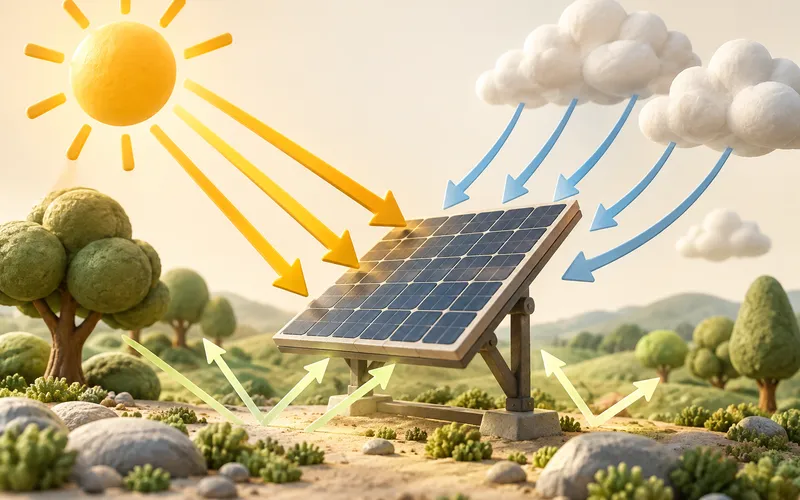
Direct beam
433 W/m²
Sky diffuse
186.6 W/m²
Ground reflected
8 W/m²

What this means

An isotropic-sky snapshot from the entered irradiance and angles, not a solar generation forecast.

How this was calculated

Based on the figures you entered.

  • Irradiance and angles are mutually consistent inputs for the same moment and location.
  • Entered directions apply to a sun at or above the horizon; the tool does not derive solar position.
  • The sky and ground reflection are treated as isotropic, with uniform ground reflectance; shading and obstructions are excluded.
  • This is an irradiance snapshot, not a generation forecast or annual energy estimate.

Method plane-irradiance-isotropic-v2

The working

The maths, step by step

direct=500×max⁡(0,cos⁡30∘)≈433.012702 W/m2\text{direct} = 500 \times \max(0, \cos 30^\circ) \approx 433.012702\ \text{W}/\text{m}^2
sky diffuse=200×[1+cos⁡(30∘)]/2≈186.60254 W/m2\text{sky diffuse} = 200 \times [1 + \cos(30^\circ)] / 2 \approx 186.60254\ \text{W}/\text{m}^2
ground reflected=600×20/100×[1−cos⁡(30∘)]/2≈8.038476 W/m2\text{ground reflected} = 600 \times 20 / 100 \times [1 - \cos(30^\circ)] / 2 \approx 8.038476\ \text{W}/\text{m}^2
total≈433.012702+186.60254+8.038476=627.653718 W/m2\text{total} \approx 433.012702 + 186.60254 + 8.038476 = 627.653718\ \text{W}/\text{m}^2

This isotropic model assumes uniform sky and ground reflection, no shading and consistent inputs for one moment. It does not calculate sun position or solar generation.

Understand your result

A closer look at the calculation

The context behind the numbers, so you can decide what to check next.

Three kinds of irradiance

Direct normal irradiance (DNI) is sunlight arriving from the sun's direction on a surface perpendicular to it. Diffuse horizontal irradiance (DHI) is scattered light arriving on a horizontal surface. Global horizontal irradiance (GHI) combines direct and diffuse contributions on that horizontal surface.

Enter values for the same location and instant. Supply an incidence angle directly, or use the directions option with an entered sun elevation, sun bearing, panel bearing and tilt. The calculator does not derive the sun position or check the physical consistency of separate weather inputs.

How light reaches a tilted plane

The direct beam is multiplied by the cosine of the angle between sunlight and the surface normal; a beam arriving behind the surface contributes zero. The incidence angle is different from the panel tilt. For entered directions the tool uses geometric projection and bearings measured clockwise from north.

The isotropic sky approximation treats diffuse sky light as uniform. The ground-reflected part uses the entered GHI and ground reflectance, or albedo. Both depend on the surface tilt.

What a snapshot can and cannot tell you

The result is irradiance in watts per square metre at one moment. It is not electricity generated by a panel or energy over a year. Panel conversion, shading, weather, temperature and system losses are not modelled.

The isotropic approximation does not represent a bright horizon or concentrated light around the sun, and the model assumes a uniform unobstructed sky and ground. Use a suitable time-series model and site data for a generation estimate.

Take it further

Solar and battery ROI calculator

You know what fits. Now see whether it pays back.

The ROI calculator takes a roof direction and system size and models generation, self-consumption, export income and replacements, all in today's prices.

Open the ROI calculator

Before you rely on this

Explore one moment of irradiance from entered DNI, DHI, GHI, angles and ground reflectance.

  • Inputs refer to the same moment and are mutually consistent; the tool does not derive sun position or verify consistency.
  • The sky and ground are isotropic and unobstructed; this is not a generation or annual energy forecast.
  • Optional direction inputs describe a sun at or above the horizon; solar position is not calculated.

Common questions

Is irradiance the same as solar electricity generated?

No. Irradiance is incoming solar power per unit area. Electrical output also depends on the panel, temperature, system losses and other conditions.

Is the incidence angle the same as panel tilt?

No. Incidence is the angle between incoming sunlight and the surface normal; tilt is the surface angle from horizontal.

Does this calculate the sun position?

No. Enter a compatible incidence angle or the sun's elevation and bearing, together with irradiance figures for the same location and moment.

Does this estimate annual solar generation?

No. It is a one-moment isotropic-sky illustration. Annual energy requires a time-series model and suitable weather and system inputs.