Time-of-use tariffs when you have solar
A cheap window and a generating roof can work against each other. How to price which you have, step by step, with the published windows.
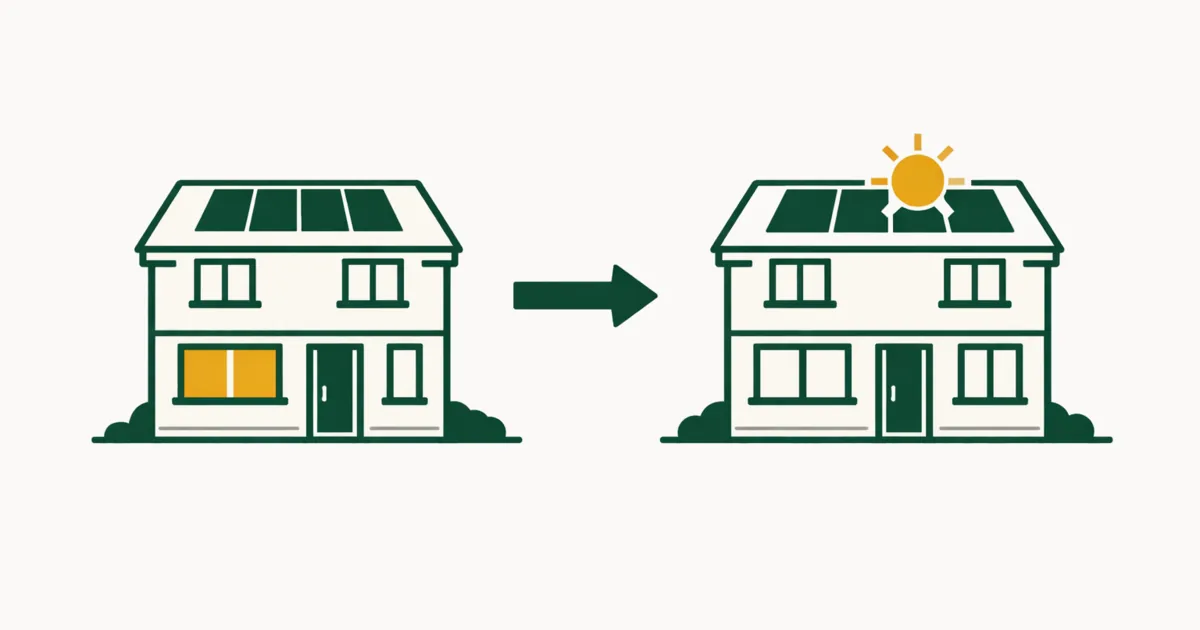
A shaped tariff and a solar array can pull against each other. The tariff makes electricity cheap at certain hours; the panels make it free at others, and those hours are frequently not the same.
Getting them to cooperate is worth doing, it starts with noticing the conflict, and the published tariff windows make the conflict concrete enough to price.
The conflict, stated plainly
Solar generates around the middle of the day. Most shaped tariffs put their cheap window overnight, Intelligent Octopus Go’s 8p between 23:30 and 05:30 being the standard example, when you generate nothing.
The consequence: during the cheap window you import at a low rate, and your panels contribute nothing. During the expensive periods your panels contribute, but the value of what they displace is high only if the expensive period coincides with generation, which for an evening peak it does not.
So the tariff and the array are optimising different hours, and the household sits between them. The widget shows each Octopus product’s published shape, one at a time from its list; it starts on Cosy, so look at where the 13:00 to 16:00 window falls, then switch product to compare.
- Cosy Octopus: Cosy periods 04:00 to 07:00, 13:00 to 16:00 and 22:00 to 00:00 at 51% below the regional day rate; peak 16:00 to 19:00 at 50% above it. Needs a heat pump, electric boiler or electric radiators.
- Windows are in UK local time as the tariff page states them. Rates on Flux and Cosy are regional and the pages give none; Agile is a different price every half hour.
- A time of use tariff rewards a household that moves load into the cheap hours and penalises one that does not: the strip is the timetable, not a saving.
- Octopus Energy, Intelligent Octopus Go (as advertised on the tariff page, checked 2026-10-20)
- Octopus Energy, Octopus Flux (as published on the tariff page, checked 2026-10-19)
- Octopus Energy, Cosy Octopus (as published on the tariff page, checked 2026-10-19)
- Octopus Energy, Agile Octopus (as published on the tariff page, checked 2026-10-19)
Illustrative arithmetic on the inputs shown. For a projection with degradation, replacement and your tariff, use the calculator.
The shapes, as each page states them
| Tariff | Cheap hours | Peak hours | Rates on the page | Who can join | Checked |
|---|---|---|---|---|---|
| Intelligent Octopus Go | 23:30 to 05:30, whole home | None stated | 8p off-peak; day rate by quote | A supported car and charger | 2026-10-20 |
| Cosy Octopus | 04:00 to 07:00, 13:00 to 16:00, 22:00 to 00:00 | 16:00 to 19:00 | Cheap periods 51% below the regional day rate, peak 50% above | A heat pump, electric radiators or electric boiler | 2026-10-20 |
| Octopus Flux | 02:00 to 05:00 | 16:00 to 19:00 | None; rates are regional, import and export both priced by period | Solar, a battery, an export MPAN, import and export with Octopus | 2026-10-20 |
| Agile Octopus | Half-hourly | Usually 16:00 to 19:00 | A different price every half hour | As the Agile post sets out | 2026-10-19 |
Two things in that table matter more than any rate. The windows are stated in UK local time, and each product has an entry ticket: the EV tariff needs the car, Cosy needs electric heating, Flux needs the battery. A solar household without the ticket is choosing between a flat tariff and Agile.
What a cheap daytime window does to solar
The value of a self-consumed unit is the import rate you avoided. On the October to December 2026 cap of 26.32p that is 26.32p. On a tariff that discounts daytime, it is less.
Cosy’s day rate is regional and its page gives no figure, so take the cap as a stand-in day rate, labelled as such. Its cheap periods at 51% below that are about 12.9p, and its 16:00 to 19:00 peak at 50% above it about 39.5p. Every solar unit used at home between 13:00 and 16:00 is then worth about 12.9p instead of 26.32p: the same generation, worth half as much per unit, because the tariff already made those hours cheap. It is also barely worth more than exporting it at Octopus Outgoing’s 12p, under a penny a unit.
Conversely, a tariff with an expensive daytime period makes your generation worth more, because each unit you generate avoids an expensive import. And the peak hours of the shapes above, 16:00 to 19:00, are exactly when a battery charged earlier is worth most.
The pattern, in order, with the pounds
- Price your generation on the candidate tariff. Split the units you use at home by the hours they fall in, and value each at that hour’s rate. This is the step most comparisons skip.
- Price your imports on it. Map each half hour of your smart meter data to the tariff’s rate and total the year.
- Add export income at each tariff’s export rate. At one supplier the open and conditional rates are 4.1p and 12p, and the shaped products have their own.
- Do the same for the flat tariff and your current one. The lowest net figure wins.
- Repeat with a battery scheduled against the shape. The battery is what turns a shape from a constraint into an instrument, so the comparison without it understates the shaped tariff for a household that has, or will buy, one.
Run it on a summer month and a winter month as well as the year, because generation dominates one and the cheap window the other, and the annual result is a blend of two different households you are both of.
A worked household: the heat pump home looking at Cosy
A heat pump home with a 4 kW south facing array making 3,400 kWh a year at the site model’s 850 per kilowatt, half used at home: 1,700 kWh. Illustratively, 40% of those self-used units, 680 kWh, fall inside the 13:00 to 16:00 Cosy period.
- Generation on a flat tariff: 1,700 kWh at 26.32p, about £447.
- Generation on Cosy: 680 kWh at about 12.9p, about £88, plus 1,020 kWh at the stand-in day rate, about £268. About £356.
- The difference: about £91 a year less for the same panels.
That £91 is step one. It does not decide the tariff, because Cosy exists to move the heat pump’s imports into its cheap periods, and steps two and three may recover it several times over. It does set the bar: whatever Cosy saves on the heating has to clear £91 before the household is ahead, which a comparison of import costs alone would never show.
What makes them cooperate
A battery. The clearest answer. Storage decouples when you generate from when you consume, and lets you charge cheaply overnight as well. Worked per unit charged in at the 90% round-trip efficiency the calculator uses, a unit from the 8p window returns about 23.7p of import and gains about 15.7p, against about 11.7p for a unit of stored solar that gave up 12p of export.
A tariff with an evening peak and a wide spread. Better for solar, because your generation and your battery both target the peak. Flux is built exactly this way, with both import and export priced in every period.
A tariff with a daytime cheap window. Worse for a solar household, not better, for the displacement reason above: the tariff and the panels are discounting the same hours twice.
Shifting loads. Free, and it works in both directions: run appliances during generation, and anything you cannot move during generation, move into the cheap window. Every shifted unit is worth the full gap it crosses.
A second household: the EV, the battery and the overnight window
A household with the same 4 kW array, an electric car that qualifies for Intelligent Octopus Go, and a 5 kWh usable battery that can charge from the grid. On a flat tariff the battery stores solar; on the EV tariff it fills every night in the window, whole home, and empties into the evening.
- Battery on stored solar, flat tariff: at best one cycle a day, 1,825 kWh charged in at about 11.7p, about £213 a year, and less in practice because winter will not fill it.
- Battery on the window, EV tariff: 1,825 kWh at about 15.7p, about £286 a year, winter included, because the grid fills it whatever the weather.
- The tariff’s effect on the battery alone: about £73 a year.
- Against it, any daytime premium. The page gives the day rate only by quote. If it ran an illustrative 2p above the flat rate on 2,500 kWh still imported outside the window, that is £50 a year, and the battery’s gain is down to about £23 before the car is counted.
The car is the larger line, and the EV tariff comparison works it through. The point here is the order: the battery’s switch from 11.7p to 15.7p a unit is real money, and the daytime premium is the number that can take it back. In summer the household may be better off exporting its surplus at 12p and filling the battery from the grid at 8p, because the grid-charged unit gains more, but only if Octopus lets it keep Outgoing on the EV tariff: its export page, checked on 20 October 2026, says EV tariff customers can pair with certain export tariffs without listing which, and describes 12p for customers on a standard import tariff. On the open 4.1p rate a stored solar unit gains about 19.6p (23.7p less 4.1p) and beats the window.
- Import at 26.32p, the Ofgem price cap unit rate (Ofgem cap, 1 October to 31 December 2026).
- Round trip efficiency of 90%, which you set; 90%, the round-trip efficiency the calculator uses, close to Tesla's stated 89% for Powerwall 3 as a whole system.
- Stored solar gives up Octopus Outgoing export rate of 12p; grid charging pays the Intelligent Octopus Go off-peak rate, 23:30 to 05:30 of 8p (as advertised on the tariff page, checked 2026-10-20).
- The gain is per kilowatt hour charged in, at the stated cycles on every day of the year. No degradation, no replacement: years to recover is a ceiling, not a projection.
Illustrative arithmetic on the inputs shown. For a projection with degradation, replacement and your tariff, use the calculator.
The export side
Shaped tariffs often come with their own export arrangement, and some price export by period too.
Where export is priced by period, exporting during an expensive window is worth considerably more. With a battery you can arrange that deliberately: hold charge through the day and export into the evening peak rather than discharging into the house.
Whether that beats self-consumption depends on whether the peak export rate exceeds the import rate you would otherwise avoid. Occasionally it does, and it only happens on tariffs that price both directions, which is precisely what makes the symmetric tariffs interesting for battery households and irrelevant for everyone else. Flux publishes its windows but not its rates, which are regional, so this is one comparison you can only run with your own quote in hand.
What the quote will say
Switch to our smart tariff and save up to 30% on your electricity.
Ask what the saving assumes about when your house uses electricity, and whether it values your solar at the tariff’s rate in the hours it generates. On the heat pump home above, the same panels are worth about £91 a year less on a tariff with a cheap afternoon, and a headline that leaves that out is pricing someone else’s house. Then ask for the day rate, the standing charge and the exit fee: Intelligent Octopus Go states a £50 early exit fee if you move tariff or supplier.
The failure mode
Switching to a shaped tariff, changing nothing about how the house runs, and finding the bill has gone up.
That is the expected outcome. These tariffs are not passive. They lower the rate in hours you must actively use and raise it in hours you must actively avoid, and the same failure mode applies across every shaped tariff, from fixed windows to half-hourly pricing.
If nothing in your household can move, and you have no storage, the flat tariff is the better product and there is no shame in it.
Questions people ask
Is a cheap overnight tariff worth it with solar panels and no battery?
Only if something else fills the window, usually a car. Without storage the panels do nothing overnight, so the cheap rate applies to whatever the house already used then, and any daytime premium applies to everything else. The EV tariff comparison works the crossover by mileage; for a solar household the daytime units are fewer, which helps.
Does a cheap afternoon window waste my solar?
It devalues it. On Cosy, with the cap standing in for the regional day rate, a solar unit used between 13:00 and 16:00 saves about 12.9p rather than 26.32p, under a penny more than exporting it at 12p. The window still suits a heat pump, which is the household it is designed for. It means the solar arithmetic must be run at the tariff’s rates, not the flat rate.
Should a battery charge from the grid or from the roof?
Whichever gains more per unit charged in. At 90% round trip, a unit from the 8p window gains about 15.7p and a unit of solar that gave up 12p of export gains about 11.7p, so on these rates the grid wins, and in summer exporting the surplus while filling the battery overnight can beat storing it. That needs 12p export alongside the EV tariff, which Octopus does not confirm; on the open 4.1p rate a stored solar unit gains about 19.6p and the roof wins. The battery-without-solar post runs the full case.
How often should I re-check?
Twice a year, and whenever the household changes. Adding a battery, adding a car or changing working patterns all move the answer, usually in the shaped tariff’s favour, and the windows and rates on the supplier’s page can change too.
Check your own numbers
Redo the five steps with current rates whenever something changes, and when the household itself changes, model the whole system rather than the tariff alone: the tariff, the panels and any storage are one machine. The calculator runs the panels, the battery and the car together in today’s money, with degradation and the battery replacement in it. Start from the second household: open the calculator with the worked example loaded.
The individual tariffs, and how export is paid, are in solar tariffs and export payments explained.
Sources
- Octopus Energy, Intelligent Octopus Go: 8p between 23:30 and 05:30 for the whole home, day rate by quote, a supported car and charger, £50 early exit fee. Checked 2026-10-20, octopus.energy.
- Octopus Energy, Cosy Octopus: cheap periods 04:00 to 07:00, 13:00 to 16:00 and 22:00 to 00:00 at 51% below the regional day rate, peak 16:00 to 19:00 at 50% above it, heat pump or electric heating required. Checked 2026-10-20, octopus.energy.
- Octopus Energy, Octopus Flux: super cheap 02:00 to 05:00, peak 16:00 to 19:00, no rates on the page, solar, battery, export MPAN and both accounts with Octopus required. Checked 2026-10-20, octopus.energy.
- Octopus Energy, Smart Export Guarantee: Outgoing at 12p and the open SEG rate at 4.1p. Checked 2026-10-19, octopus.energy.
- Ofgem, Changes to the energy price cap between 1 October and 31 December 2026: 26.32p per kWh. Checked 2026-10-20, ofgem.gov.uk.
- gowith.solar, What the calculator models, for the 850 kWh per kilowatt figure and the 90% round-trip efficiency the calculator uses, what the calculator models.
- The 40% of self-use inside the Cosy afternoon, the 5 kWh battery and its £4,000 price, the 2p daytime premium on 2,500 kWh, the 30% in the quote box and both households are illustrations, labelled as such.
Related
- Octopus solar tariffs: Outgoing Octopus and the alternatives, in numbersHow the outgoing, tracking and time of use options differ, and which generation and consumption patterns each one actually suits.
- Why your export rate matters less than your self-consumptionA unit you use is worth several times a unit you sell. Everything sensible about running a solar system follows from that one fact.
- Intelligent Octopus Go: the EV tariff that schedules your carA cheap overnight window plus supplier-controlled charging. What you give up for the rate.