Getting paid for flexibility: Saving Sessions, the Demand Flexibility Service and virtual power plants
What Saving Sessions, NESO's Demand Flexibility Service and battery virtual power plants say they pay, what they leave out, and what they add to a battery.
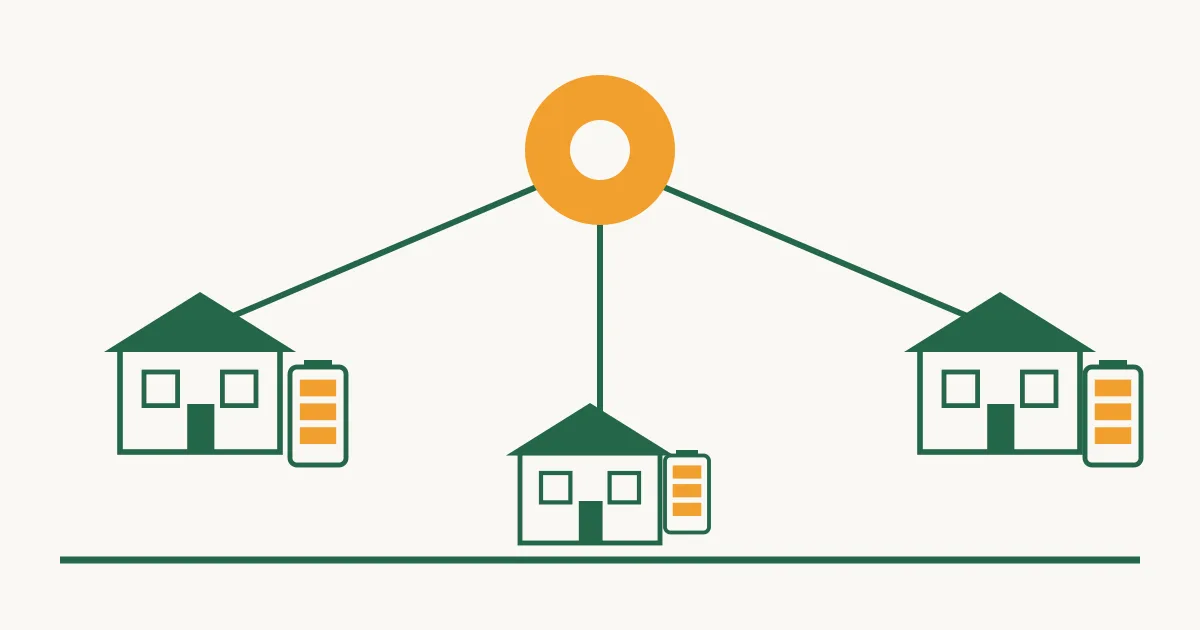
A home battery can earn from the tariff, and it can also earn from being useful to the grid. The second route has a lot of names: Saving Sessions, the Demand Flexibility Service, virtual power plants. They share one idea. At a few moments a year the grid is short of power, or has too much, and someone will pay a household to use less or more for an hour or two.
This page sets out what each scheme says, what it leaves out, and how to treat it in a battery’s return. The short version is that the schemes pay real money but publish little that you can plan around, so they belong beside the tariff arithmetic, not inside it. Everything is in today’s money.
The three things people mean
Octopus Saving Sessions. A programme run by one supplier for its own customers. You are told about a session, you opt in, and you earn rewards points for the change in your use against normal.
The Demand Flexibility Service. A scheme run by the system operator, NESO, which buys flexibility from suppliers and aggregators. Households take part through one of those providers, never directly.
Virtual power plants. A company links many home batteries and sells their combined response to the grid, then passes on a share of the payments. The household’s part is to let the company control the battery.
Octopus Saving Sessions
The Saving Sessions page, checked 25 October 2026, describes two kinds. In a Power Down session you are paid in Octopoints for every kilowatt hour you save. In a Power Up session you are rewarded for the extra electricity you use compared to normal. The page says Power Up events fall anytime between 11am and 4pm, after a green light at around 10am each day.
Octopus’s Octoplus page gives the conversion: 800 Octopoints equal £1, so one Octopoint is worth about 0.125p. That is the only number in the scheme that is both stated and stable.
What the scheme does not state
| Item | What the page says | Checked |
|---|---|---|
| Payment per kWh in a session | Not stated; the page gives no per-kilowatt-hour rate | 2026-10-25 |
| How many sessions there will be | Not stated; the page says it is hard to say and hopes for lots | 2026-10-25 |
| Season dates for 2026/27 | Not stated | 2026-10-25 |
| Whether battery discharge counts | Not mentioned on the page | 2026-10-25 |
| Octopoints to pounds | 800 Octopoints = £1 | 2026-10-25 |
| Who can join | Octoplus members with a smart meter sending half-hourly readings; the page names a Direct Debit or smart prepay | 2026-10-25 |
| Meter data needed | Readings for at least 80% of the last 20 days, per the Octoplus page | 2026-10-25 |
The payment per session is shown in the app at the time, so there is no honest way to quote a yearly total in advance. Be wary of any figure that does. The page also does not say whether a battery counts: your use is measured at the meter, so a battery that covers your evening load would lower your meter reading and plausibly counts, but the page does not say so and Octopus is the one to ask in writing.
The Demand Flexibility Service
NESO’s explainer, checked 25 October 2026, says suppliers or aggregators contact you when an event is scheduled and explain the timing, length and the action that earns a reward. You choose whether to respond. If you change your use, your provider pays you; if you sign up and do not change, you usually earn nothing, with no penalty.
To take part as a household you need to live in England, Scotland or Wales, be with a supplier or aggregator registered for the service, and have a working smart meter. The page says the service has run year-round since 27 November 2024, and that from 14 April 2026 eligible participants may also be rewarded for using electricity at times that help balance the system.
What it pays: not stated. NESO says rewards are set by each provider and vary in type and value, so there is no national rate to quote.
What NESO does publish is how the scheme was used. For winter 2024/25, its own review reports nearly 2 million households and businesses registered, 44 events between 27 November 2024 and 28 March 2025, and 3,917.7 megawatt hours reduced or shifted, at a total cost of £1.2 million. The article gives no split for homes alone and no figures for batteries. Read it as a sign of scale and frequency: dozens of events in a winter, each short. It is not a per-household income.
Virtual power plants
A virtual power plant is a commercial product, so its terms are the company’s own. Take them as claims and read the contract.
One example: Sunsave’s terms say a guaranteed monthly payment and its period are specified in your sales documents, that the guarantee can pause if you are asked to re-enrol your devices, and that if the service is ended or suspended, guaranteed payments stop. A trade report on its battery package says some customers have earned as much as £30 a month on top of their bill savings, and adds that payments vary with demand. That is the company’s own claim about the best cases, not an average and not a promise.
An older example shows the same shape. SolarEdge’s 2023 launch let owners of its battery join the Demand Flexibility Service, with owners of eligible smart meters paid for cutting grid use during events, and those with an export meter able to earn more by sending stored energy back. The trade report stated no payment rates.
The pattern across all of them is the same: a payment exists, its size is not published in advance, and it depends on you giving up some control of the battery.
What it adds to a battery’s return
A flexibility payment is a bonus on a battery that is already earning, not a reason to buy one. The way to treat it is as a line you add last.
A worked household
Take the 6 kWh battery at an illustrative £3,500 from the retrofit return post, with a cheap overnight window and grid charging, earning about £344 a year from the tariff alone. That is about 10.2 years to recover the price.
Now suppose flexibility paid something on top. The arithmetic needs no scheme figures at all:
- A top-up of £34.40 a year is 10% on £344. At the 800 to £1 rate that is 27,520 Octopoints a year, and £3,500 over £378.40 is about 9.2 years.
- A top-up of £100 a year takes the earnings to £444, and £3,500 over £444 is about 7.9 years.
- A top-up of £0 leaves the payback at about 10.2 years.
Those top-ups are illustrations, chosen to show the leverage, not forecasts or the going rate of any scheme. The point is that a payment worth tens of pounds shortens a ten year payback by about a year, while one worth £100 shortens it by more than two. Which one you get is not something the schemes let you know up front.
The widget shows what the battery earns from the tariff, so you can add whatever your own provider actually pays on top.
- Import at 26.32p, the Ofgem price cap unit rate (Ofgem cap, 1 October to 31 December 2026).
- Round trip efficiency of 90%, which you set; 90%, the round-trip efficiency the calculator uses, close to Tesla's stated 89% for Powerwall 3 as a whole system.
- Stored solar gives up Octopus Outgoing export rate of 12p; grid charging pays the Intelligent Octopus Go off-peak rate, 23:30 to 05:30 of 8p (as advertised on the tariff page, checked 2026-10-20).
- The gain is per kilowatt hour charged in, at the stated cycles on every day of the year. No degradation, no replacement: years to recover is a ceiling, not a projection.
Illustrative arithmetic on the inputs shown. For a projection with degradation, replacement and your tariff, use the calculator.
The conflict to watch
A battery cannot do two things at once. If a virtual power plant discharges it during an event, it may be less full when your own tariff schedule wants it, and the reverse. Ask the company how it handles that: whether you can set a reserve, whether you can opt out of an event, and what happens to your tariff gain on an event night. A payment that costs you more in lost arbitrage than it pays is a bad trade.
Questions people ask
Do Octopus Saving Sessions pay for a home battery?
The Saving Sessions page does not mention batteries and states no rate per kilowatt hour. Rewards are measured against your normal use at the meter, so ask Octopus in writing whether discharging a battery counts toward the saving before you count on it.
How much does a Saving Session pay?
Not stated on the scheme page. Each session shows its reward in the app. The only fixed figure is the conversion: 800 Octopoints are worth £1.
How often are Saving Sessions and DFS events held?
Octopus says it cannot say how many sessions there will be. NESO’s review counted 44 service events in winter 2024/25. Neither promises a number for this winter, so do not size a battery around them.
Can I join the Demand Flexibility Service directly?
No. NESO says you sign up through a registered supplier or aggregator, in England, Scotland or Wales, with a working smart meter.
Is a virtual power plant payment guaranteed?
Only as far as the contract says. Sunsave’s terms, for example, put the guaranteed amount and period in the sales documents and say guaranteed payments stop if the service ends. Read the equivalent terms for any scheme.
Check your own numbers
Work out what your battery earns from your tariff first, then treat any flexibility payment as an extra with a range from nothing upward. The calculator runs the battery’s return year by year in today’s money with fade and replacement applied. Start from a 4.4 kW array with a 6 kWh battery and compare it with the battery set to zero: open the calculator with the worked example loaded.
Next: why a battery on a cheap overnight window earns more and the rest of the home battery guides.
Sources
- Octopus Energy, Saving Sessions: Power Down and Power Up sessions; no per-kWh rate, season or battery treatment stated. Checked 2026-10-25, octopus.energy.
- Octopus Energy, Octoplus: 800 Octopoints = £1; smart meter readings for at least 80% of the last 20 days. Checked 2026-10-25, octopus.energy.
- NESO, Demand Flexibility Service explained: how it works, eligibility, year round since 27 November 2024, expanded from 14 April 2026, no payment amounts given. Checked 2026-10-25, neso.energy.
- NESO, Nearly 2 million households and businesses registered for DFS last winter: 44 events, £1.2 million, 3,917.7 MWh, winter 2024/25. Checked 2026-10-25, neso.energy.
- Sunsave, Virtual Power Plant guarantee terms: amount and period stated in sales documents. Checked 2026-10-25, sunsave.energy.
- Renewable Energy Magazine, Sunsave launches no upfront cost home batteries, 12 October 2026: some customers have earned as much as £30 a month; payments vary with demand. Checked 2026-10-25, renewableenergymagazine.com.
- Solar Power Portal, SolarEdge launches battery virtual power plant, 8 February 2023: no payment rates stated. Checked 2026-10-25, solarpowerportal.co.uk.
- The £3,500 battery, its £344 tariff earnings and the £34.40 and £100 top-ups are illustrations, labelled as such. No scheme payment rate is quoted because none is stated.
Related
- How a battery changes your payback, for better and worseStorage raises the saving and raises the cost. Which effect wins depends on one rate difference, worked through for two households at published rates.
- Home battery ROI: what a battery earns when you add it to solar you already ownA retrofit battery is judged on its own price and earnings. Two worked households, the cost per cycled kWh, and payback in today's money.
- Home battery storage without solar: does it pay?Tariff arbitrage alone can justify a battery. When the spread between cheap and expensive rates makes the sums work, and when it does not.